
I own both the PlanetBox Rover and the PlanetBox Shuttle, and after using them for preschool, outings, and beach days with my 2-year-old, I can confidently say they solve two slightly different problems.
The Rover gives me more compartments and more flexibility. The Shuttle is smaller, deeper, lighter to carry, and much easier to fit into a toddler backpack.
Neither is universally better. The better PlanetBox depends on how much food your child eats, whether you pack full meals or snack-style lunches, and how much lunchbox you want your child lugging around.
PlanetBox Rover vs. Shuttle at a Glance
For most everyday lunches, I prefer the PlanetBox Rover. Five compartments make it ridiculously easy to turn whatever I have on hand into a decent lunch. A little fruit here, cheese or crackers there, something more substantial in the large compartment, and suddenly I look much more organized than I actually was five minutes earlier.
The PlanetBox Shuttle is better for portability. It has only two compartments and holds less food overall, but it takes up considerably less space. It also has deeper compartments than the Rover, which is surprisingly useful.
My toddler can open and close both by himself. He carries both sometimes, usually while proudly announcing “do it,” his current shorthand for “I will be handling this myself, thank you.” But the Shuttle is noticeably easier for him to carry, and unlike our Rover, it fits inside his backpack.
One caveat: PlanetBox currently recommends both the Rover and Shuttle for ages 3+, and the product care instructions warn that the lunchboxes contain small parts and are not intended for children under 3. My child is 2 and uses them with me, but my experience should not be interpreted as changing the manufacturer’s age guidance.
My quick take…
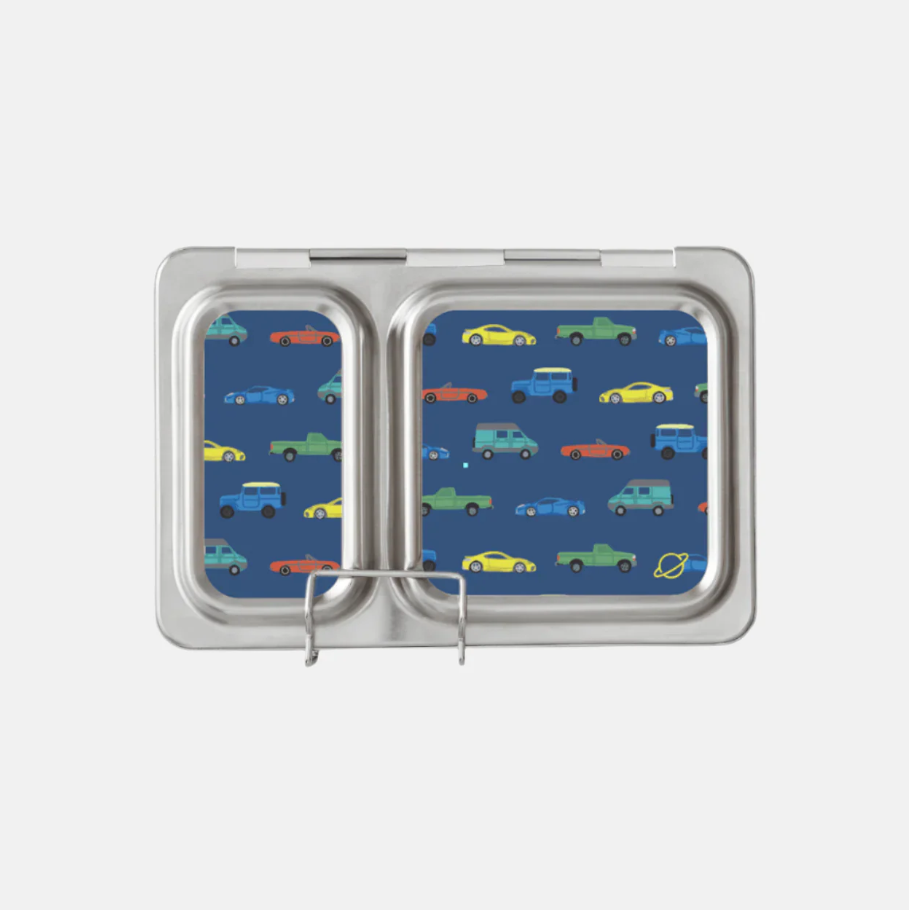
for smaller appetites, snacks, shorter school days, compact backpacks, and outings where you do not need five separate compartments.
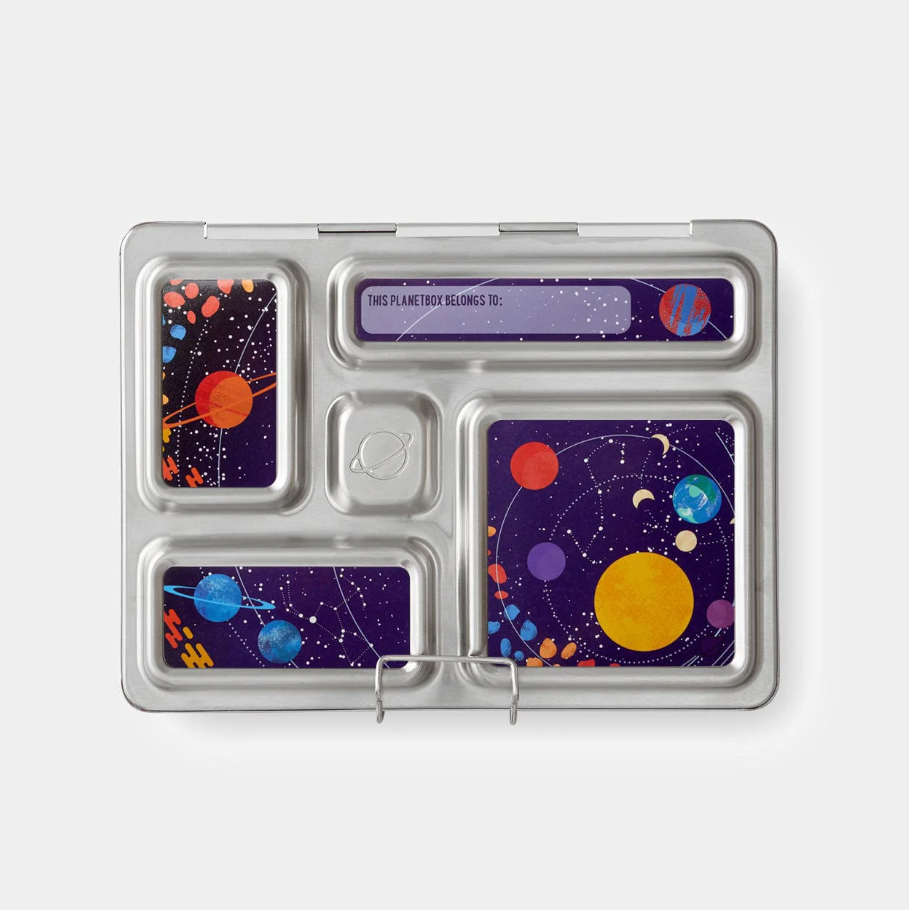
for full lunches, kids who like variety, picky eaters, older children who can carry more, and anyone who wants more built-in separation.
PlanetBox Rover vs. Shuttle Comparison Table
| Feature | PlanetBox Rover | PlanetBox Shuttle |
|---|---|---|
| Dimensions | 10 x 7.4 x 1.5 in. | 7.8 x 5.2 x 2 in. |
| Capacity | 4.5 cups | 3.5 cups |
| Compartments | 5 | 2 |
| Depth | 1.5 in. | 2 in. |
| Current box weight | 1.6 lb | Not currently listed on product page |
| Approx. complete carried system** | 2.6 lb | 1.3 lb |
| Main food-contact tray | 49% post-consumer recycled 18/8 304 stainless steel | 53% post-consumer recycled 18/8 300-series stainless steel |
| Lid | 18/0 430 stainless steel | 18/0 400-series stainless steel |
| Included food containers | Big + Little Dipper | Tall Dipper |
| Dippers leakproof? | Yes | Yes |
| Main compartments leakproof? | No | No |
| Dishwasher safe | Yes, remove magnets first | Yes, remove magnets first |
| Manufacturer age guidance | 3+ | 3+ |
| Regular list price*** | $54.95 | $39.95 |
| Current sale price*** | Shop Back to School Sale | Shop Back to School Sale |
| Best for | Full lunches, variety, snack-style meals | Small lunches, snacks, portability |
Current PlanetBox Rover specifications
Current PlanetBox Shuttle specifications
**Includes the PlanetBox carry bag and listed accessories, not food.
***Prices verified July 25, 2026. Both lunchboxes were part of PlanetBox’s back-to-school sale at the time of this update, so the sale price can change.
The Biggest Difference Between the PlanetBox Rover and Shuttle
It is tempting to think of the Shuttle as simply a smaller Rover. It really isn’t.
The Rover spreads 4.5 cups across five shallow compartments. The Shuttle holds 3.5 cups in two deeper compartments. That changes the way you pack them.
The Rover lends itself to variety. Its largest compartment can hold the main part of lunch while the smaller sections handle fruit, vegetables, cheese, crackers, or whatever odds and ends are saving me from having to make an actual recipe that morning.
The Shuttle gives you fewer decisions. One large section. One smaller section. Done.
And despite being the smaller lunchbox overall, the Shuttle is actually half an inch deeper than the Rover. Its main compartment is about 4.25 x 4.25 x 2 inches compared with the Rover’s roughly 4 x 4 x 1.5-inch main compartment. PlanetBox publishes those compartment dimensions specifically for helping parents figure out whether sandwiches will fit.
That extra depth matters more than I expected.
My biggest frustration with the Rover is that it is shallow. A piece of corn on the cob can be too tall for the lid to close, and I wish I had a little more vertical room for things like cute rice balls.
The Shuttle has less total capacity, but its deeper design can accommodate thicker foods more easily.
PlanetBox Rover Review
I bought the Rover first.
The five-compartment design was what sold me. I wanted stainless steel, plenty of food separation, and a latch my child could learn to operate independently.
That last part worked exactly as I hoped. My toddler can open and close his Rover himself, and he is extremely pleased about this development.

Rover Size and Capacity
The current Rover measures 10 x 7.4 x 1.5 inches and PlanetBox lists a capacity of 4.5 cups across five compartments. The box itself currently weighs 1.6 pounds before food, accessories, or a lunch bag are added.
The compartments give plenty of variety and opportunities for my 2-year-old.
When I’m rushing, I can toss several easy foods into separate sections and somehow a random collection of snacks becomes lunch.
The limitation is not really capacity for us. It is depth.
Foods that are thick or tall can become awkward even when there is plenty of unused capacity elsewhere in the box.
Rover Compartment Layout
The Rover has four regular food compartments plus a tiny center compartment intended for a small treat or bite. I usually put nuts or raisins there.
For the way I feed my toddler, the compartment layout is the Rover’s strongest feature. I can offer several foods without pulling out separate containers.
It also gives me more flexibility with a child whose food preferences can apparently be revised without notice.
The downside is that those five built-in compartments dictate the shape of your lunch. You cannot redistribute the space when you want to pack one bulky food.
That is where a larger but less divided container can sometimes be more versatile.
What I Like About the Rover
The Rover makes snack-style lunches incredibly easy.
I do not have to plan a traditional entrée plus sides. I can fill several compartments with simple foods and end up with plenty of variety.
I also really like the latch. My child can open and close it independently, which matters for preschool.
And aesthetically, the magnets are cute. They’re completely unnecessary from a lunch-packing standpoint, but my toddler enjoys them and they make a stainless steel box much more fun.
What I Don’t Love About the Rover
First, it is heavier than I expected.
The Rover itself weighs 1.6 pounds according to the current product specifications. PlanetBox estimates a Rover with its two Dippers, magnets, and Carry Bag at approximately 2.6 pounds before you add lunch.
My toddler does carry it himself sometimes, but the weight difference became one of the reasons I eventually bought the Shuttle.
Second, the built-in compartments are not leakproof.
I learned this very quickly with watermelon. Something exceptionally juicy can release enough liquid to escape the box and make the surrounding lunch bag or backpack wet.
PlanetBox itself recommends putting yogurt, applesauce, dips, and other wet foods into the leakproof Dippers rather than the open stainless compartments.
Third, I wish the Rover were deeper. The five-compartment layout is excellent for variety, but the 1.5-inch depth limits bulky foods.

I own and use the PlanetBox Rover with my toddler, and its five compartments make it especially easy to pack a varied lunch from simple foods. The recycled stainless steel set includes two leakproof Dipper containers for yogurt, applesauce, sauces, and other wet foods. The main compartments are not leakproof, and the box is heavier and shallower than it appears, but it remains my favorite of the two for everyday lunches.
The current Rover has five compartments and includes two leakproof Dippers. PlanetBox identifies it for ages 3+ and instructs users to remove the decorative magnets before washing.
The Annual PlanetBox Back to School Sale is back! Save up to 60% sitewide, including 20% off all lunch boxes. No promo code needed! Sale goes from July 7th to Sept 20th.
Who the Rover Is Best For
Of the two, I would start with the Rover if your priority is a versatile everyday lunchbox.
It makes the most sense for children who eat several different foods at lunch (and don’t want them to touch each other), and families who want enough capacity to keep using the same box as a child’s appetite increases.
The biggest reasons to choose something else are weight (it’s quite heavy for a toddler), backpack space, and the shallow compartments.
PlanetBox Shuttle Review
I bought the Shuttle because I liked the Rover, but I did not always want to carry the Rover.
The difference was obvious as soon as I started using it.
The Shuttle is significantly more compact, my toddler has an easier time carrying it himself, and most importantly for preschool logistics, it fits inside his small backpack.
The Rover does not.
Shuttle Size and Capacity
The Shuttle measures 7.8 x 5.2 x 2 inches and holds 3.5 cups of food across two compartments. PlanetBox describes it as its smallest lunchbox and positions it for lighter meals, snacks, and smaller appetites.
The Shuttle with its magnets, Tall Dipper, and carry bag weighs approximately 1.3 pounds total, compared with 2.6 pounds for the equivalent Rover setup.
That tracks with my experience. The Shuttle feels much more manageable for my toddler.
Shuttle Compartment Layout
You get two compartments rather than five.
This sounds dramatically more limiting than it actually feels for a small child.
The larger compartment does most of the work, while the smaller compartment gives you space for a side. The current Shuttle holds one cup less food overall than the Rover, but both compartments are deeper.
For simple lunches, I don’t necessarily need five sections. I reach for the Shuttle when I’m packing leftovers rather than a toddler snack party.
Where I notice the limitation is variety. If I want to pack multiple fruits, vegetables, crackers, cheese, and another food without mixing them, the Rover’s layout is much easier.
What I Like About the Shuttle
Portability.
That is the reason I bought it, and it does exactly what I needed.
My toddler can carry it more easily. It takes up less room. It fits in his backpack.
I also appreciate that the Shuttle is actually deeper than the Rover. I expected the smaller box to feel more restrictive in every dimension, but it doesn’t.
What I Don’t Love About the Shuttle
Like the Rover, the stainless steel compartments themselves are not leakproof.
Wet or very juicy food still needs a sealed container unless you are comfortable risking a wet bag.
The included Tall Dipper is designed for that job. PlanetBox currently describes its Shuttle-compatible Tall Dipper as leakproof, with an 18/8 stainless steel bowl and food-grade silicone lid.
The second compromise is obvious: two compartments cannot offer the same built-in variety as five.
PlanetBox Shuttle Stainless Steel Lunch Box Set
The PlanetBox Shuttle is the smaller, more portable option I reach for when my toddler needs a light lunch or snack. Its two compartments are deeper than the Rover’s, and the compact box fits inside his backpack and is noticeably easier for him to carry. It includes a leakproof Tall Dipper for yogurt, applesauce, or dips, although the main lunchbox compartments are not leakproof.
PlanetBox currently describes the Shuttle as its smallest lunchbox, with two compartments, a 3.5-cup capacity, and an included Tall Dipper. It is intended for ages 3+.
The Annual PlanetBox Back to School Sale is back! Save up to 60% sitewide, including 20% off all lunch boxes. No promo code needed! Sale goes from July 7th to Sept 20th.
Who the Shuttle Is Best For
The Shuttle makes more sense for a child with a smaller appetite, a toddler’s first lunch box, a light lunch, an outing, or any situation where you want to minimize what your child has to carry.
I especially like it for backpack use.
It can absolutely function as a lunchbox for a smaller eater, but I would choose the Rover instead if you routinely pack a lot of sides or want a box with more room to grow.
Rover vs. Shuttle for Toddlers and Preschoolers
This is one of the more useful comparisons because “which PlanetBox is best for toddlers?” does not have a simple answer.
From a capacity standpoint, the Shuttle makes intuitive sense for a smaller eater.
From a variety standpoint, I actually prefer the Rover for my toddler because I can offer several small portions.
From a carrying standpoint, Shuttle.
My toddler can open and close both by himself, but the Shuttle is easier for him to carry and fits inside his backpack.
The Rover is heavier, but I don’t consider it automatically too large for a toddler’s appetite. Depending on his mood, variety of choice often wins with a toddler.
There is an important manufacturer warning here, though. PlanetBox currently categorizes both boxes for ages 3+ and says its products contain small parts and are not intended for children under 3. My own child began using them at 2, but that is my experience, not a recommendation to ignore PlanetBox’s guidance.
For preschoolers over 3, I would decide primarily based on appetite and whether the lunchbox needs to fit inside a backpack.
Rover vs. Shuttle for School Lunch
Between these two, I think the Rover makes more sense as a child’s appetite grows.
You get one extra cup of stated capacity and, more importantly, five separate places to put food instead of two.
The Rover works particularly well if your school lunch formula looks something like:
main food + fruit + vegetable + crunchy side + small extra
You do not have to add individual cups or silicone dividers every time you want foods separated.
The Shuttle is better when lunch is simpler:
main food + side
It also makes sense for half-day preschool programs, snack-heavy school schedules, or children who consistently come home with half of a larger lunch untouched.
You may also find these Posts helpful
back to school the non-toxic way

Which PlanetBox Is Easier to Pack?
The Rover is easier for variety. The Shuttle is easier for simplicity.
PlanetBox lists the Rover’s large compartment at approximately 4 x 4 x 1.5 inches and the Shuttle’s at approximately 4.25 x 4.25 x 2 inches. That makes the Shuttle’s main compartment slightly wider and considerably deeper even though the box has less total capacity.
For sandwiches or wraps, either can work depending on the size and how you cut them.
For fruit, cheese, crackers, vegetables, and other small foods, I prefer the Rover because separation is already built in.
For yogurt, applesauce, dips, and wetter leftovers, I would use a Dipper rather than either lunchbox compartment. I’ve successfully packed yogurt and applesauce that way.
Larger or thicker foods are where the Rover can frustrate me. Corn on the cob is my personal example. I have room for it horizontally, but not necessarily enough height to close the box.
Cute rice balls have the same problem if I make them too tall.
The Shuttle’s 2-inch depth gives you more vertical flexibility, despite the smaller overall box.
Which Is Easier for Kids to Carry?
Shuttle, in my house. Easily.
PlanetBox’s current FAQ estimates the full Rover + magnets + two Dippers + Carry Bag at 2.6 pounds, while the Shuttle + magnets + Tall Dipper + Shuttle Carry Bag is approximately 1.3 pounds. Food adds more weight to either setup.
Even as an adult, I could tell the difference.
For a preschooler carrying a backpack that already contains a water bottle, spare clothes, and whatever random toy has been deemed essential that morning, it matters.
My son will carry the Rover himself. He’s very proud when he does.
I just would not choose the Rover because you expect it to be lightweight.
Are PlanetBox Lunchboxes Leakproof?
The Rover and Shuttle compartments are not leakproof.
This is probably the single most important limitation to understand before buying either one.
Dry foods and foods without much free liquid are easy.
Watermelon is another story.
I’ve had very juicy fruit release liquid that escaped the lunchbox and got the lunch bag or backpack wet. I would not put something like yogurt, applesauce, dressing, or a saucy dish directly in one of the stainless compartments and expect the exterior to stay dry.
PlanetBox recommends using its Dippers for wet foods including yogurt, applesauce, and dips. The company says closing the PlanetBox puts pressure on the Dipper lids to engage their seals. It also recommends blotting especially juicy fruit before packing.
PlanetBox wet-food packing instructions
I’ve used the Dippers for applesauce and yogurt successfully.
PlanetBox Rover compartments: not leakproof
PlanetBox Shuttle compartments: not leakproof
PlanetBox Dippers: designed to be leakproof
If wet-food flexibility is a top priority, PlanetBox now sells other designs specifically marketed as leakproof, but that is a different lunchbox system than the Rover or Shuttle.
Cleaning and Durability After Real Use
Cleaning is one of the easiest parts of owning either box.
Both are smooth stainless steel and dishwasher safe. PlanetBox instructs you to remove the decorative magnets before washing, dry the lunchbox thoroughly, and then put the magnets back on.
Taking the magnets off adds an extra step, but it takes seconds and doesn’t bother me. They’re cute enough that putting them on every day is actually fun.
I have not had issues with staining, lingering odors, scratching, dents, or noticeable wear on either box.
PlanetBox backs its stainless steel products with a five-year warranty against covered defects in materials or workmanship for the original purchaser. Soft goods receive a one-year warranty, subject to the company’s warranty terms.
What About the Materials?
Materials were one of the reasons I bought PlanetBox in the first place.
I prefer having stainless steel as the main food-contact surface for a reusable lunchbox, especially for something that goes through constant filling, washing, and reuse.
We are lucky enough that our school does allow glass, so sometimes I’ll just send leftovers in a small glass container, but I know a lot of schools do not allow that. So, if you can’t bring glass, stainless steel is 100% the way to go.
PlanetBox’s FAQ says the company uses 18/8 and 18/0 stainless steels across its products and says its products are tested by CPSC-accepted third-party laboratories for applicable FDA, CPSC, and CPSIA requirements.
PlanetBox Rover vs. Shuttle Accessories
The most important PlanetBox accessories are the Dippers.
For me, they are less “accessory” and more “how you pack yogurt without ruining everyone’s day.”
The Rover set currently includes a Big Dipper and Little Dipper, while the Shuttle includes a Tall Dipper. The Little Dipper and the Tall Dipper are pretty small, but PlanetBox also sells additional square Dippers, including Shuttle-compatible options for larger portions of wet foods.
Then there are the magnets.
Do you need magnets? Absolutely not.
But they are so much fun! Plus the Rover magnets include a space to write your child’s name, which I appreciate. It improves the aesthetic of having to label every individual item your kid brings to school.
Just remember to take them off before you put it in the dishwasher!
What about PlanetBox lunch bags and PFAS?
I originally had concerns because the material disclosures for the bags were not always as clear as I wanted.
That has changed.
PlanetBox’s current FAQ now explicitly states that its bags are PFAS/DWR-free and provides material details for the Carry Bag, Shuttle Carry Bag, Slim Sleeve, Lunch Sack, Lunch Tote, and Small Carry Bag.
For my Shuttle, another option is simply putting the lunchbox directly into my child’s backpack because it actually fits.
The Rover does not fit in his current backpack, so it needs a separate carrying solution.
For more options for kids, adults, school, work, and day trips, see my guide to the best PFAS-free lunch bags and coolers.
Rover vs. Shuttle: Which One Is Worth the Money?
At the time of this update, PlanetBox lists the Rover at a regular price of $54.95 and the Shuttle at $39.95. Both are currently discounted during their annual back-to-school sale.
The Rover costs more, but I think it offers better value if you’re buying one PlanetBox to serve as a primary lunchbox.
You get more capacity, more compartments, and a layout that can adapt from tiny toddler portions to substantially larger lunches without requiring you to fill every section from day one.
The Shuttle is less expensive and better suited to a narrower job: small lunches, snacks, and portable meals.
That does not make it poor value. In fact, if a child consistently eats a modest lunch, paying more for capacity you never use doesn’t accomplish much.
I am glad I have both.
Having two also means whichever one isn’t currently in the dishwasher gets lunch duty. And when you have kids and don’t have time for dishes, that matters.
My Verdict: PlanetBox Rover or Shuttle?
Choose the Rover if:
Choose the Shuttle if:
If I had to choose just one, I would buy the Rover again. The five compartments make packing easier for me, and that’s ultimately what wins.
I can throw several simple foods into it and have lunch packed without using half my collection of little containers.
But I wouldn’t give up the Shuttle. It is easier for my toddler to carry, fits inside his backpack, and the deeper compartments solve a frustration I have with the Rover.
|
Best for Variety
|
Best for Small Appetites
|
|
Pros:
|
Pros:
|
|
Cons:
|
Cons:
|
|
Best For:
Everyday lunches and kids who like variety
|
Best For:
Smaller appetites, preschool, snacks, and outings
|
- Five compartments make snack-style lunches easy
- Heavy and surprisingly shallow
- Compact, deeper, and easier for my toddler to carry
- Only two compartments and still not leakproof
Some frequently asked questions
Final Thoughts
For us, Rover and Shuttle are not duplicates.
The Rover is my favorite because I use all those compartments. The Shuttle is the one I appreciate when my toddler is carrying his own lunch or I need everything to fit into his backpack.
If I were buying only one as an everyday lunchbox, I would choose the Rover for its versatility.
If size and portability are the priority, I would buy the Shuttle.
And since I own both, my actual system is even simpler: whichever one is clean gets packed.
You Might Also Like…
View all posts