PFAS-free air fryers are a good start, but we didn’t stop there.
A lot of air fryers are marketed as safer simply because they do not use PTFE or Teflon. That still leaves some big questions unanswered, including what the cooking surface actually is, whether a ceramic coating is nano or non-nano, and whether aluminum sits underneath it.
For this update, I used a stricter materials standard. I looked at what food actually touches, how clearly each brand discloses those materials, and whether the product relies on “proprietary” nonstick coatings or simpler materials like glass and stainless steel.
That means some air fryers marketed as PFAS-free still did not make my best list.
In this guide, I break down which models have the ⭐ best verified materials, ✅ which ones may still be a meaningful step up from conventional nonstick, and ❌ which ones I would skip based on incomplete disclosure or hard-no materials under this standard.
My Quick Top Picks for the Safest Non-Toxic Air Fryers
What a PFAS-Free Claim Does Not Tell You
A PFAS-free label is a good start. It is not a full safety story.
With an air fryer, food sits directly on the basket, tray, crisper plate, or pan while hot air moves around it fast. That means the actual cooking surface matters just as much as the headline claim on the box.
This is why two air fryers can both be marketed as PFAS-free and still feel very different once you look closer. One may use glass or stainless steel where food touches. Another may rely on a coated surface with limited detail about what it is made from.
For me, that difference matters. I do not just want to know what a brand left out. I want to know what is actually there.
🔍 What Can Still Be Hiding Behind a PFAS-Free Claim
“PFAS-free” sounds reassuring, but it can leave out a lot.
It may not tell you whether the cooking surface is coated, what metal is underneath, whether plastic parts sit near heat, or why a product carries a Prop 65 warning. Those details can change how I rank an air fryer.
That is why I break the red flags out one by one below. PFAS is only one part of the picture.
PFAS
PFAS are a large group of fluorinated chemicals used in products that resist heat, grease, and sticking. The EPA says they break down very slowly, and some have been linked to harmful health effects in people and animals.
In air fryers, the main red flag is fluoropolymer nonstick, especially PTFE, better known as Teflon. State disclosure documents also treat PTFE, PFA, and FEP as PFAS-related fluoropolymers, which is why I use one simple rule: avoid PFAS on any surface that directly touches food.
It is also worth knowing that PTFE is not meant to be overheated. Germany’s Federal Institute for Risk Assessment says PTFE-coated cookware should not be heated empty or overheated, because the coating can begin to decompose.
One last wrinkle: coatings can change by model, year, and accessory. That is why I trust manuals, disclosures, and material specs more than a clean-sounding marketing claim.
Aluminum
Aluminum is popular in cookware because it is lightweight, cheap, and conducts heat well. It also has one big drawback for this conversation: it can migrate into food under the right conditions.
That migration tends to get worse with acidic ingredients, longer contact time, and harsher cooking conditions. In one study, pretreating aluminum cookware reduced aluminum leaching dramatically, which tells you the surface condition matters a lot.
This is why I care so much about what sits under a coating. A PFAS-free or ceramic-coated air fryer can still rely on aluminum for the basket, crisper plate, or tray, and if the brand does not disclose that clearly, I do not think you should have to guess.
For me, bare glass and stainless steel are easier choices because they remove that extra layer of uncertainty. Coated aluminum may still be a better option than conventional PTFE for some shoppers, but it is not the same thing as a fully clean food-contact surface.
Phthalates
Phthalates are chemicals used to make some plastics softer and more flexible. The FDA says they have been used in certain food-contact applications, and NIEHS includes phthalates among endocrine-disrupting chemicals.
In air fryers, I am not usually worried about a hard exterior button. I care more about plastic in the hot zone, lids sitting over steaming food, flexible liners, gaskets, and any plastic part that touches food directly or sits close to it.
A BPA-free label is a start, but it does not answer the whole plastic question. If a brand uses plastic near the cooking chamber and does not clearly say what it is made from, I do not count that as reassuring.
That is why I still prefer glass and stainless steel where possible.
Are Basket, Oven-Style, and Glass Bowl Air Fryers Non-Toxic?
Not necessarily. Format helps, but it does not tell the whole story.
What matters most is the actual cooking surface and the included accessories. A basket model can be PFAS-free and still rely on a coated basket or crisper plate, while an oven-style model can have a mostly stainless interior but still come with a coated bake pan or air fry basket.
That said, even glass models are not automatic passes. A glass container can still come with a direct food-contact crisper plate or insert that changes the whole picture, which is exactly why I review the parts, not just the format.
What I Require Before I Recommend an Air Fryer
I’m sharing this so you can vet any air fryer yourself, even if I never mention that model here.
For this update, I personally reached out to every brand on my shortlist to ask follow-up questions about food-contact materials, PFAS/PTFE status, nano vs. non-nano coatings, substrate metals, and any technical documentation they could share. That matters because if a brand will not clearly identify what food touches, I treat those details as unverified.
Before I ranked any model, I checked product pages, manuals, disclosure documents, and brand responses to verify what food actually touches.
what I look for
What I Avoid
Before You Shop…
Many of the items below ship with Amazon Prime. Not a member yet? Prime Trial offers new customers a 30-day trial for Prime or a 6-month trial for Prime for Young Adults.
⭐ The Best Non-Toxic Air Fryer Brands in 2026
I vetted each recommendation carefully. I read official product pages, safety data, and third-party tests where available. I also contacted companies for clarification on coatings.
⭐ Magnifique The Combo Air Fryer
Magnifique gave me one of the clearest materials disclosures of any brand I contacted.
The company states that the Combo uses a borosilicate glass pot and lid, stainless steel crisper disk, and stainless steel steam rack.
More importantly, in a direct response to my questions, Magnifique said the food-contact parts do not contain ceramic, enamel, sol-gel coatings, nonstick coatings, PFAS, PTFE, PFOA, BPA, aluminum, aluminum oxide, titanium dioxide, or intentionally added nanoparticles.
That is an unusually simple materials profile for an air fryer. Instead of relying on a proprietary “healthy” coating, the primary food-contact surfaces are glass and stainless steel.
The Combo also functions as more than an air fryer, with settings for Slow Cook, Steam, Braise, Rice, Proof, Pasta, Oatmeal, and Keep Warm.
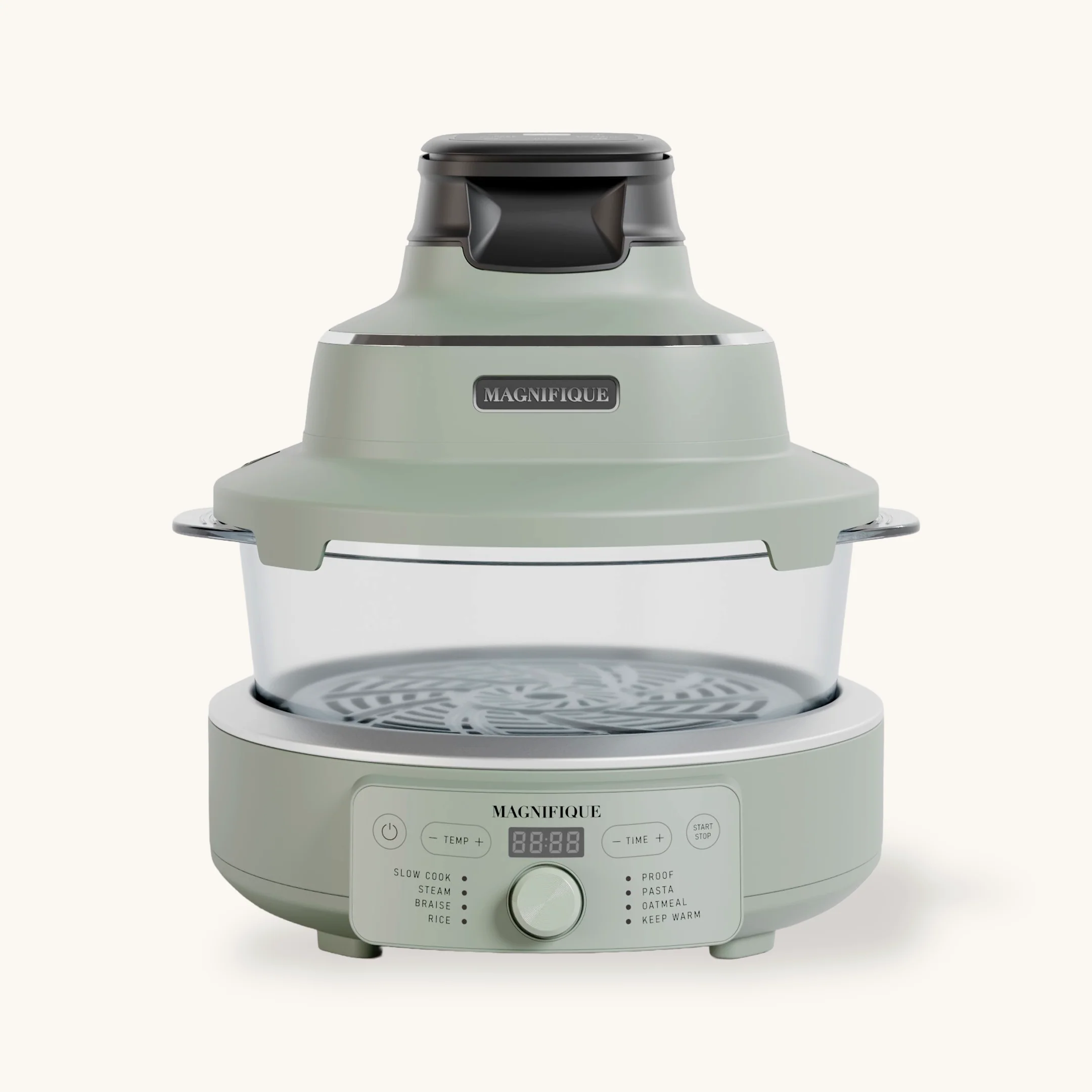
My top overall pick for a non-toxic air fryer, largely because of its excellent food-contact materials. The Magnifique Combo uses a borosilicate glass cooking pot and lid with a stainless steel crisper plate, avoiding the coated cooking baskets found in most conventional air fryers. It also works as a multi-cooker, giving you air frying, slow cooking, steaming, braising, rice cooking, and more in one appliance.
Best for: Anyone prioritizing the cleanest food-contact materials without giving up everyday versatility.
Pros: Borosilicate glass pot and lid • Stainless steel crisper plate • No traditional nonstick coating • Minimal plastic food contact • Air fries and slow cooks • Multiple cooking modes • One appliance can replace several others
Cons: More components than a basic air fryer • Smaller air-frying area than a full countertop oven • Glass cooking vessel is heavier • Higher price than a basic basket model
⭐ Magnifique The Casserole Air Fryer
The Casserole takes a similarly simple approach but in a larger, more traditional air-fryer format.
Based on the materials information provided for this model, food cooks in a borosilicate glass casserole vessel with a metal air-frying tray, rather than inside a conventional coated basket.
I have less detailed technical documentation for the Casserole than I do for the Combo, so I would still like to see a complete parts-by-parts materials disclosure from Magnifique for this specific model.
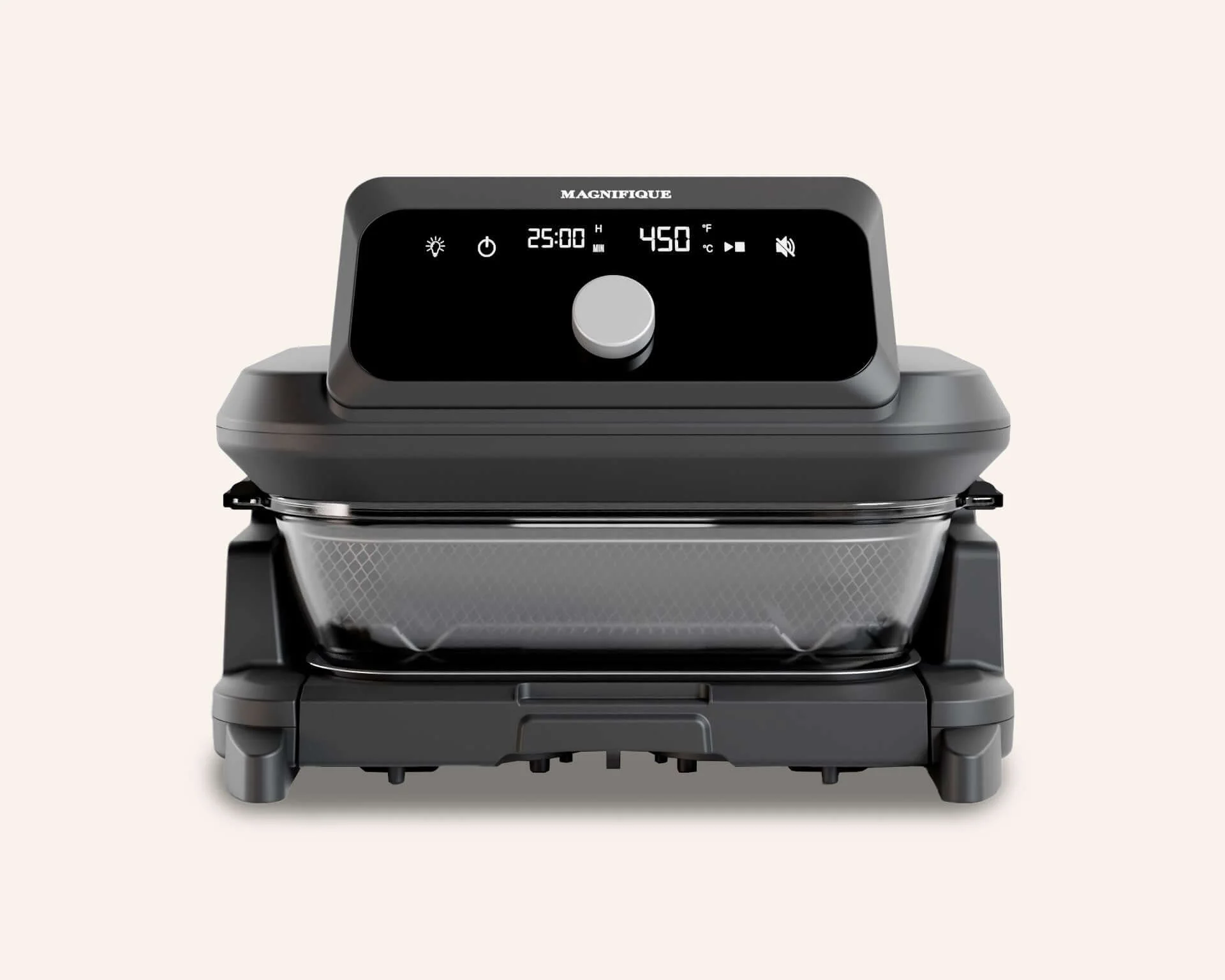
My favorite option if you want the simplicity of a traditional basket-style air fryer without the usual coated basket. Food cooks inside a borosilicate glass casserole with a metal frying basket, giving you a familiar air-fryer experience while significantly reducing coated food-contact surfaces. The glass dish is also nice enough to bring straight to the table.
Best for: Families who want a simple glass air fryer that feels closest to a traditional basket model.
Pros: Borosilicate glass cooking vessel • No traditional nonstick cooking pot • Familiar basket-style design • Glass dish doubles as servingware • Easy to monitor food while cooking
Cons: Metal basket is chromium-plated steel rather than stainless steel • Less versatile than the Combo model • Glass vessel can be heavier to handle
⭐ NuWave Combi Steam Oven
NuWave provided a strong direct response when I asked about the materials used in the Combi Steam Oven.
The company confirmed that the oven interior is stainless steel, the cooking accessories are stainless steel, the unit is PFAS-free, and the Combi Steam Oven does not contain aluminum.
That matters because aluminum interiors, coated trays, and nonstick accessories are extremely common in countertop air fryer ovens.
I would still love to see NuWave publish a full parts-by-parts materials sheet, but the direct confirmation from the company gives this model a much stronger materials profile than most oven-style air fryers I researched.

My pick for anyone who wants air frying plus the benefits of steam cooking. The NuWave Combi Steam Oven combines air frying, steaming, convection cooking, and sous vide-style precision in a roomy countertop oven. The stainless steel interior and cooking accessories make it especially appealing compared with ovens that rely heavily on coated trays and baskets.
Best for: Families who want a large countertop oven for air frying, steaming, roasting, baking, and reheating.
Pros: Stainless steel interior • Stainless steel accessories • Air fry and steam functions • Large family-friendly capacity • Precise temperature and humidity control • Excellent for reheating without drying food out
Cons: Takes up considerably more counter space • More complicated than a basic air fryer • Higher price point • Probably overkill if you only want simple air frying
⭐ Fritaire Non-Toxic Air Fryer
Fritaire takes a different approach from traditional basket-style air fryers by using a clear tempered glass cooking chamber with stainless steel accessories.
The main cooking chamber does not rely on the typical nonstick-coated metal basket, and Fritaire markets the appliance as PFAS-free and PFOA-free.
There is one caveat worth knowing. The rotisserie assembly contains a small plastic component inside the cooking area that helps provide the rotation.
I have contacted Fritaire requesting a more detailed materials disclosure and am still waiting for its response. I’ll update this guide if the company provides additional information.

My favorite pick if you want a glass air fryer with true rotisserie capability. Fritaire uses a transparent glass cooking bowl with stainless steel accessories, letting you avoid the typical coated air fryer basket while still getting that crispy, circulating-air cooking style. The included rotisserie setup is what really makes this one stand out, especially for chicken, kebabs, vegetables, and other foods that benefit from even browning.
Best for: Anyone who wants a cleaner-material air fryer with rotisserie functionality and the ability to watch food cook.
Pros: Glass cooking bowl • Stainless steel accessories • No traditional nonstick basket • Rotisserie function • Easy to monitor food while cooking • Compact compared with oven-style models • Self-cleaning function
Cons: Smaller capacity than full-size countertop ovens • Glass bowl is heavier than a standard basket • Not as versatile as the Magnifique Combo • Shape can be less convenient for larger flat foods like pizza or sheet-pan-style meals
⭐ Our Place Wonder Oven Pro
I originally contacted Our Place for detailed materials information about the Wonder Oven because countertop ovens can hide quite a few different materials behind a simple product description.
In that correspondence, Our Place explained that the bake pan uses a cast aluminum base with a sol-gel ceramic nonstick coating made without PFAS, PTFE, PFOA, lead, cadmium, or BPA. The company also told me that nano-sized materials may be involved during the coating manufacturing process.
That coated bake pan is the component I am least enthusiastic about.
For anyone who otherwise likes the Wonder Oven design, my preferred workaround is simple: use an uncoated stainless steel baking pan instead of the included ceramic-coated aluminum pan whenever possible.
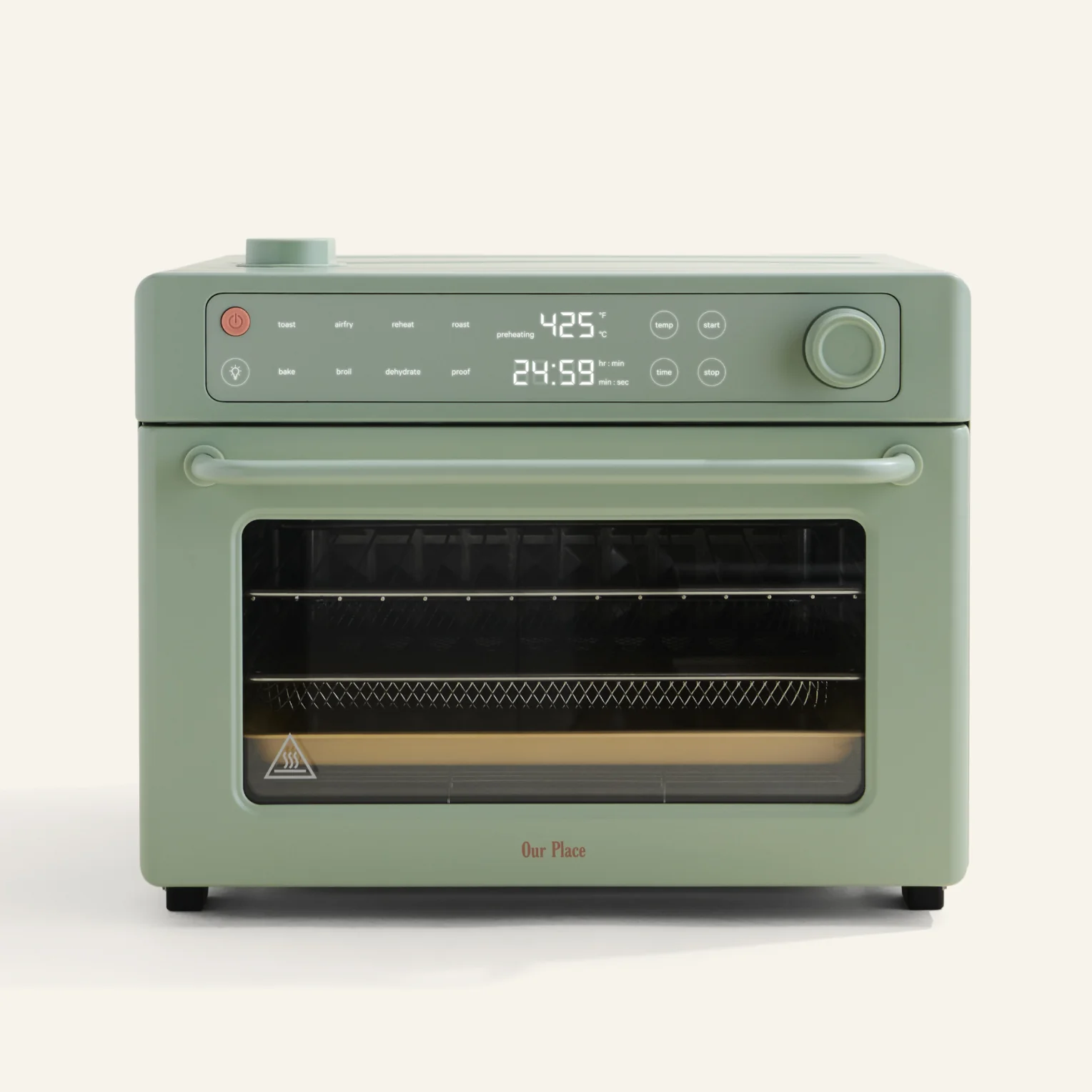
My favorite family-sized air fryer oven for everyday cooking. The Wonder Oven Pro has a roomy 30-liter capacity with a stainless steel interior, glass door, steel air fryer basket, wire rack, and crumb tray. It can air fry, bake, roast, toast, broil, reheat, proof, and dehydrate, making it a much more practical everyday appliance than a small basket air fryer.
Best for: Families who want a roomy air fryer and toaster oven in one attractive countertop appliance.
Pros: Stainless steel interior • Steel air fryer basket and racks • Large 30L capacity • Multiple rack positions • Air fries, bakes, roasts, toasts, broils, reheats, proofs, and dehydrates
Cons: Included bake pan is aluminum with a ceramic nonstick coating • Larger countertop footprint • Higher price than basic basket air fryers
Stainless steel bake pan swap: The included Wonder Oven Pro bake pan is ceramic-coated aluminum. If you’d rather cook on uncoated stainless steel, the E-far 12.4 x 9.7-inch Stainless Steel Baking Sheet with Rack is a good alternative. It’s made from uncoated 18/0 stainless steel and is oven-safe to 450°F. At 12.4 x 9.7 inches, it is smaller than the Wonder Oven Pro’s 13.8 x 11-inch bake pan, so it should fit comfortably inside while leaving room for airflow. It is not an official Our Place accessory, so always double-check dimensions before ordering.
Is Ceramic Cookware Non-Toxic?
A lot of PFAS-free air fryers use “ceramic nonstick”. This usually does not mean a solid, inert piece of ceramic. In most cases, it means a sol-gel coating made from silica, metal oxides, and binders that is sprayed onto metal and cured at lower temperatures than traditional ceramic.
A ceramic-coated basket or pan is still a manufactured coating system, not the same thing as cooking on plain glass or stainless steel. And because those formulas are often “proprietary”, brands do not always clearly tell you what is in the coating.
The nano issue is part of that. In a NIST study on nanoceramic cookware, washing, scouring, and scratching increased titanium and silicon migration compared with fresh pans. Under the most aggressive abrasion test, the researchers also detected titanium dioxide and silicon dioxide nanoparticles, and aluminum migration increased in one sample.
A non-nano ceramic claim may sound more reassuring, but the public research is still limited. It is still a coating, it can still wear down, and it is still not the same thing as cooking on simple materials like glass and stainless steel.
For me, that is the takeaway. If I can choose glass or stainless steel instead of a coated surface, that is still the cleaner option.

✅ Low-Tox (PFAS Free But Not Perfect)
These ✅ picks all have PFAS-free cooking surfaces. They’re better than most mainstream fryers, but I label them Low-Tox because some use aluminum under ceramic coatings. If you can’t get a ⭐ Cleanest model, these are solid alternatives that avoid Teflon and serious toxins.
✅ GreenPan Elite Air Fryer Oven
GreenPan provided one of the more detailed coating disclosures I received during my research.
In response to my questions, the company said its Thermolon ceramic nonstick coating is made without PFAS, including PTFE and PFOA, and does not contain lead, cadmium, BPA, or nanoparticles. GreenPan also said the sol-gel coating is sprayed onto the pan body without glues or additives.
The important caveat is how extensively that coating is used. According to GreenPan, the interior oven walls, baking pan, pizza pan, air fry basket, and crumb tray are all ceramic-coated, with aluminum underneath the coating.
That is why I classify the Elite as a Low-Tox option rather than one of my cleanest picks. The coating disclosure is much stronger than the vague “healthy nonstick” claims I see from many brands, but this is still a heavily coated cooking system rather than a simple glass-and-stainless-steel setup.
If you choose it, I would treat the coating gently, avoid abrasive cleaning tools, and replace any accessory that becomes significantly scratched or worn.

My pick for a large air fryer oven if you’re comfortable with ceramic nonstick. GreenPan is more transparent about its coating than many brands I researched. Its Thermolon ceramic coating is made without PFAS, including PTFE and PFOA, and GreenPan says it contains no lead, cadmium, BPA, or nanoparticles. The tradeoff is that this oven relies heavily on coated surfaces, with ceramic nonstick over an aluminum base.
Best for: Anyone who wants a large, versatile oven-style air fryer and is comfortable with PFAS-free ceramic nonstick.
Pros: Made without PTFE, PFOA, or other PFAS • No lead or cadmium disclosed • No nanoparticles disclosed • Large oven-style capacity • 13 cooking functions • Better coating transparency than many ceramic brands
Cons: Ceramic-coated interior walls and accessories • Aluminum beneath the coating • Requires gentler care to protect the coating • Not as simple or durable a materials setup as glass and stainless steel
❌ Toxic Air Fryer Brands to Avoid
These brands failed our criteria. If a fryer uses undisclosed PTFE, aluminum, or nano-ceramics without proof of safety, I won’t recommend it. So far, GreenPan is the only brand with unavoidable ceramic coatings that gave full non-nano disclosure.
❌ Ninja Crispi
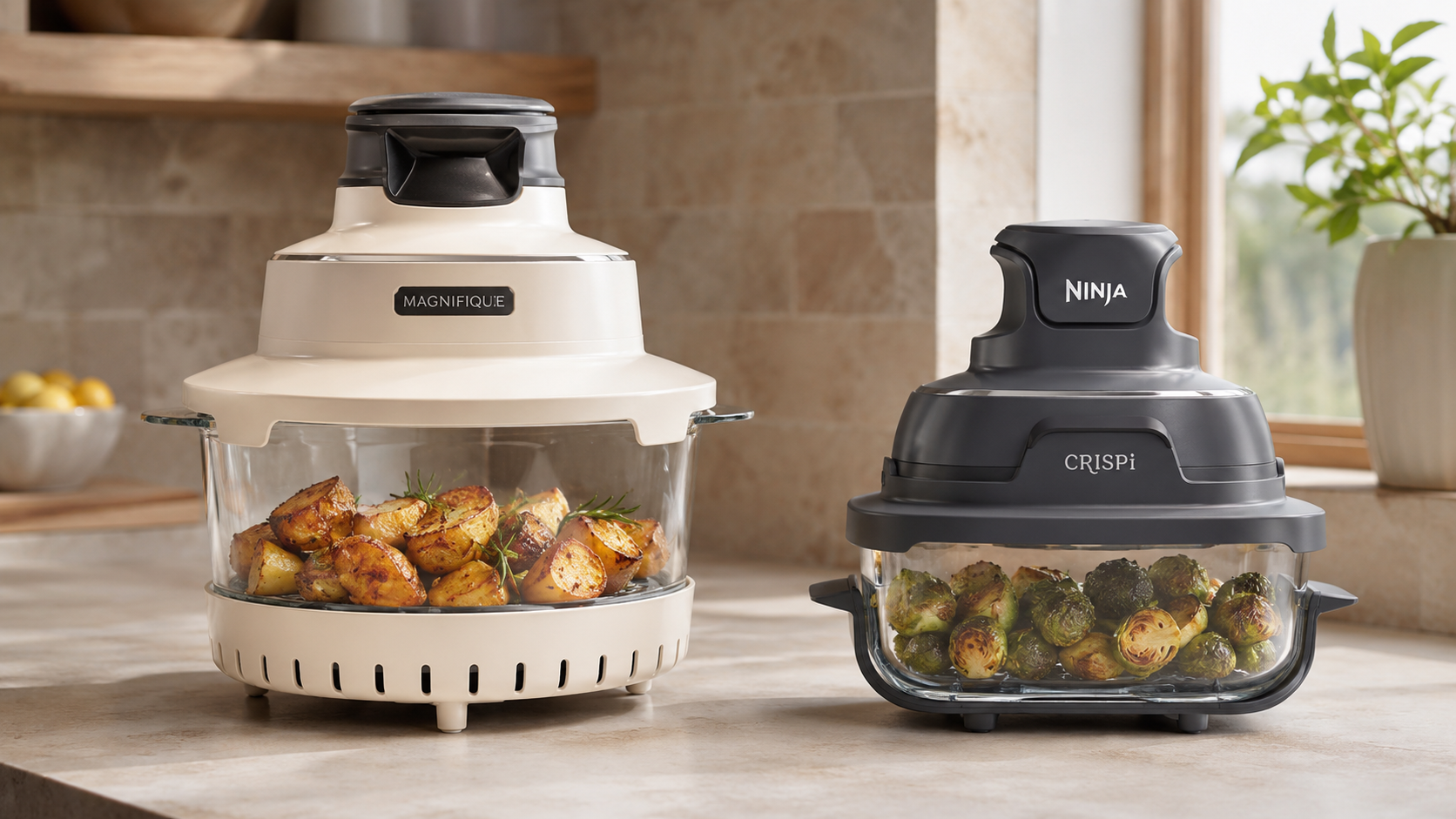
The Ninja Crispi looks appealing because the containers are borosilicate glass. But that is not the full story.
The dealbreaker is the direct food-contact crisper plate. Ninja explicitly discloses aluminum crisper plates with a nano-ceramic coating, and under this stricter standard, nano-ceramic on a food-contact surface is a hard no.
❌ NuWave Bravo Models
NuWave was more transparent than many brands, and I do appreciate that.
But after reviewing the materials breakdown, the Bravo models still use aluminum-plated steel inner walls and an aluminum-plated steel crumb tray. Since NuWave offers a better option in the Combi Steam Oven, I do not see a strong reason to choose this one.
If you are already looking at NuWave, I would skip the Bravo line and look at the NuWave Combi Steam Oven instead. Based on the brand response I received, the Combi Steam Oven has a stainless steel interior, stainless steel accessories, is PFAS-free, and does not contain aluminum, which is a much better fit for the stricter materials standard I used here.
❌ Typhur Air Fryers
Typhur did not give me the exact materials disclosure I asked for, which is a major red flag in a guide like this.
Instead of clearly naming the food-contact materials, the brand leaned on broad reassurance about PFAS-free, food-grade, UL-certified, and heat-tested materials.. When I followed up for specifics, the reply still only described the interior as “metal and food-grade silicone” with a fluorine-free ceramic nonstick coating, plus a handle made from high-temperature engineering plastic.
I found the responses evasive, and I am not comfortable with interior silicone near high heat when better alternatives already exist.
Some frequently asked questions
How To Avoid Greenwashed Air Fryers
“Ceramic” ≠ safe automatically:
If it doesn’t say exactly what the coating is, be skeptical. True ceramic coatings (like Thermolon) are PFAS-free by design, but many off-brand ones aren’t. Ask the company: Where is it from, what’s it made of?
“Stainless steel” can hide aluminum:
Some ovens have “stainless baskets” but an aluminum pan or walls. Even if brushed stainless looks safe, find out if there’s an inner aluminum insert.
Claim vs. certification:
A label “PFOA-free” is meaningless now (PFOA has been banned for years). Look for independent verification. Few have it, so instead rely on proven engineering (all-glass or all-304 steel).
Packaging tricks:
Some brands emphasize a single safe feature on the box while ignoring others. E.g. advertising a “glass lid” but forgetting to mention an aluminum tray inside. I always check the fine print of every major part.
Empty words:
“Healthy cookware” or “eco-friendly” are marketing. If the product page or manual doesn’t list exact materials, that’s a red flag. Legit non-toxic products usually wear their credentials.
Non-Toxic Air Fryers for Peace of Mind & Healthy Home Cooking
A safer air fryer is not just about avoiding one chemical family. It is about knowing what your food actually touches every time you cook.
That is why I went beyond PFAS-free claims in this guide. For me, the best picks are the ones with simple, clearly disclosed food-contact materials and as little mystery as possible.
Some PFAS-free models can still be reasonable lower-tox options. But if a brand hides behind vague coating language, skips key material details, or expects me to trust a surface I cannot verify, it does not earn a top spot.
I am not looking for perfect. I am looking for fewer question marks in the kitchen and recommendations I can stand behind with confidence.
If you want the cleanest path, start with air fryers that use glass and stainless steel where food touches. They are easier to verify, easier to trust, and a lot easier to recommend.
Top Choices Recap
Check Out These Favorites