360 Cookware and Heritage Steel are two of the bigger names I keep coming back to when I’m looking at premium stainless steel cookware. Both are made in the U.S. using globally sourced materials, and both skip PFAS-based nonstick coatings.
But they cook a little differently, and that matters more than the marketing language.
360 Cookware uses a thicker 3-ply construction and is best known for its Vapor Cooking method, which uses a tight-fitting lid and very little added water. Heritage Steel’s Titanium Series uses a 5-ply build with a 316Ti stainless steel cooking surface and internal aluminum layers to help distribute heat.
After comparing the materials, prices, warranties, performance, and everyday usability of both brands, Heritage Steel Titanium Series is my pick for most people.
It’s less expensive for comparable pieces, performs very well, can go in the oven up to 800°F and under the broiler, and feels more like traditional stainless steel cookware you can start using without learning a whole new cooking method.
That said, I would choose 360 Cookware if Vapor Cooking is the feature you’re actually excited about. I was skeptical of how much of it was just clever branding, but there is a real difference in the way the fitted lids help hold in moisture. If you regularly cook vegetables, chicken, or other foods that do well with gentle, low-water cooking, I can see the appeal.
For more cookware that fits the same coating-free material standards I use here, see my best non-toxic cookware guide.
360 Cookware vs. Heritage Steel: Quick Verdict
360 COOKWARE
💧 Best for: Low-water and Vapor Cooking
🧱 Construction: 3-ply, 2.7 mm, T-316 stainless + aluminum + magnetic stainless
✅ Biggest advantage: Purpose-built Vapor Cooking system
⚠️ Biggest drawback: Higher price and heavier cookware
HERITAGE STEEL TITANIUM SERIES
🍳 Best for: Everyday premium stainless steel cooking
🧱 Construction: 5-ply, 316Ti stainless + three aluminum layers + magnetic stainless
✅ Biggest advantage: Strong performance, high-heat versatility, and better overall value
⚠️ Biggest drawback: Rounded handle can be awkward when pouring
🏆 MY PICK: HERITAGE STEEL
For most people, Heritage Steel Titanium Series is the better buy. It costs less for comparable pieces, performs very well, can handle the oven and broiler at much higher temperatures, and is easier to use like traditional stainless cookware.
I’d choose 360 Cookware instead if Vapor Cooking is one of the main reasons you’re shopping. That fitted-lid system is its biggest advantage and the clearest reason to pay more.
360 Cookware vs. Heritage Steel Comparison Table
| Feature | 360 Cookware | Heritage Steel Titanium Series |
|---|---|---|
| Primary line compared | Current stainless cookware line | Titanium Series |
| Food-contact surface | T-316 stainless steel | 316Ti stainless steel |
| Nickel | 360 describes interior as 18/10, or 10% nickel | 316Ti specification allows roughly 10 to 14% nickel |
| Titanium | No titanium claim | Titanium is a stabilizing component of the stainless alloy, not a coating or solid titanium surface |
| Construction | 3-ply, fully clad | 5-ply, fully clad |
| Core | One aluminum layer | Three aluminum layers |
| Exterior | Magnetic T-400 series stainless steel | Magnetic 400-series ferritic stainless steel |
| Thickness | 2.7 mm / .110 inch | Varies by piece: 3.0 mm 10.5″ fry pan; 2.3 mm 4-qt sauté |
| Aluminum touches food? | No | No |
| Exposed aluminum edge? | Yes, 360 explicitly says the rim is unsealed | Rim sealing not clearly disclosed; cooking surface encloses the aluminum core |
| Nonstick coating | None | None |
| PFAS / PTFE | Brand states none | Brand states none |
| Induction compatible | Yes | Yes |
| Gas / electric | Yes | Yes |
| Oven limit | 500°F | 800°F |
| Broiler | Not specifically stated for primary cookware | Yes |
| Dishwasher | Product pages may say dishwasher-safe, but care and warranty guidance strongly favor hand washing | Hand washing recommended |
| Handles | Riveted hollow stainless; long handles designed to limit heat transfer | Riveted hollow stainless; rounded Titanium Series handle |
| Pouring rim | Conventional rim | Rounded easy-pour lip |
| Lids | Stainless steel; fitted lids used for Vapor Cooking | Stainless steel |
| Manufacturing | Cookware formed and finished in West Bend, Wisconsin using global materials | Cookware and lids manufactured in Clarksville, Tennessee using global materials |
| Clad metal source | South Korea | South Korea |
| Warranty | Lifetime defects warranty, subject to exclusions | Lifetime defects warranty for original purchaser, registration required within 30 days |
| 10-ish inch skillet regular price | 10″ fry pan: $189.95 | 10.5″ fry pan: $149.95 |
| Comparable set | Home Chef, 5 vessels + 4 lids: $1,235 regular price | Titanium 10-Piece, 5 vessels + 5 lids: $949.95 standard bundle price |
| Main advantage | Specialized low-water Vapor Cooking system | Strong construction, conventional versatility, oven performance, value |
| Best for | Cooks specifically interested in waterless or low-water cooking | Most buyers looking for premium bare stainless cookware |
Specifications and regular prices were checked July 30, 2026. Temporary promotions are discussed separately below. Current 360 specifications come from its materials documentation and current product pages; current Heritage specifications come from its Titanium Series documentation and individual product pages.
The Biggest Differences Between 360 Cookware and Heritage Steel
If you are trying to decide between these two, I think four differences actually matter.
1. 360 has its own cooking method
360 Cookware‘s biggest differentiator is Vapor Cooking.
With its covered cookware, you heat the food until steam begins escaping, spin the lid, then lower the heat once moisture creates a seal between the lid and pan. From there, foods can cook gently with very little added water.
Heritage Steel cooks more like traditional stainless steel. There is no special technique to learn.
For me, this is the biggest deciding factor. If Vapor Cooking sounds useful, 360 offers something genuinely different. If it doesn’t, Heritage is much easier to justify.
2. Heritage uses 316Ti stainless steel
Heritage’s Titanium Series has a 316Ti stainless steel cooking surface.
Despite the name, this is not a solid titanium pan or a titanium coating. Titanium is a small part of the stainless steel alloy itself.
Its practical benefit is improved corrosion resistance. It does not make the pan nonstick or give it the properties of solid titanium cookware.
3. 3-ply vs. 5-ply matters less than you might think
360 is 3-ply. Heritage Titanium is 5-ply.
I would not choose between them based on that number alone.
360’s cookware is about 2.7 mm thick, while Heritage varies by piece from roughly 2.3 to 3.0 mm. The amount of aluminum inside, total thickness, weight, and shape all affect cooking performance.
More plies do not automatically mean a better pan.
4. Heritage gives you more for the money
In every comparable size I checked, Heritage cost less at regular price.
It also has an 800°F oven rating and is broiler-safe, while 360 is rated to 500°F.
Unless you specifically want Vapor Cooking, Heritage gives you more everyday versatility for less money.
Materials: What Actually Touches Your Food?
This is the part I care about most in a non-toxic cookware comparison.
Both brands use bare stainless steel cooking surfaces with aluminum sealed inside the cookware for heat conduction. Neither uses a conventional PFAS/PTFE nonstick coating.
That internal aluminum is very different from cooking directly on bare aluminum.
360 Cookware
360 uses:
The aluminum does not form the cooking surface.
One detail worth knowing is that 360’s rim is not sealed, so the thin aluminum layer is visible at the edge. The company warns that certain dishwasher detergents can damage it.
My solution is easy: I would hand wash 360 Cookware.
Heritage Steel Titanium Series
Heritage uses:
Again, the aluminum is inside the cookware rather than forming the cooking surface.
Heritage also states that its Titanium Series contains no PFAS, PTFE, PFOA, PFOS, or ceramic-style nonstick coating.
What about the titanium?
The Titanium name makes this sound more complicated than it is.
316Ti is stainless steel with a small amount of titanium added to the alloy.
It is designed for corrosion resistance and stability. It is not a titanium coating and it does not make the cookware behave like nonstick.
Both cookware lines also contain nickel. Heritage’s 316Ti can actually contain more nickel than standard 18/10 stainless, so I would not assume the Titanium Series is automatically a better choice for someone specifically trying to minimize nickel exposure.
You may also find these Posts helpful
find your next kitchen swap
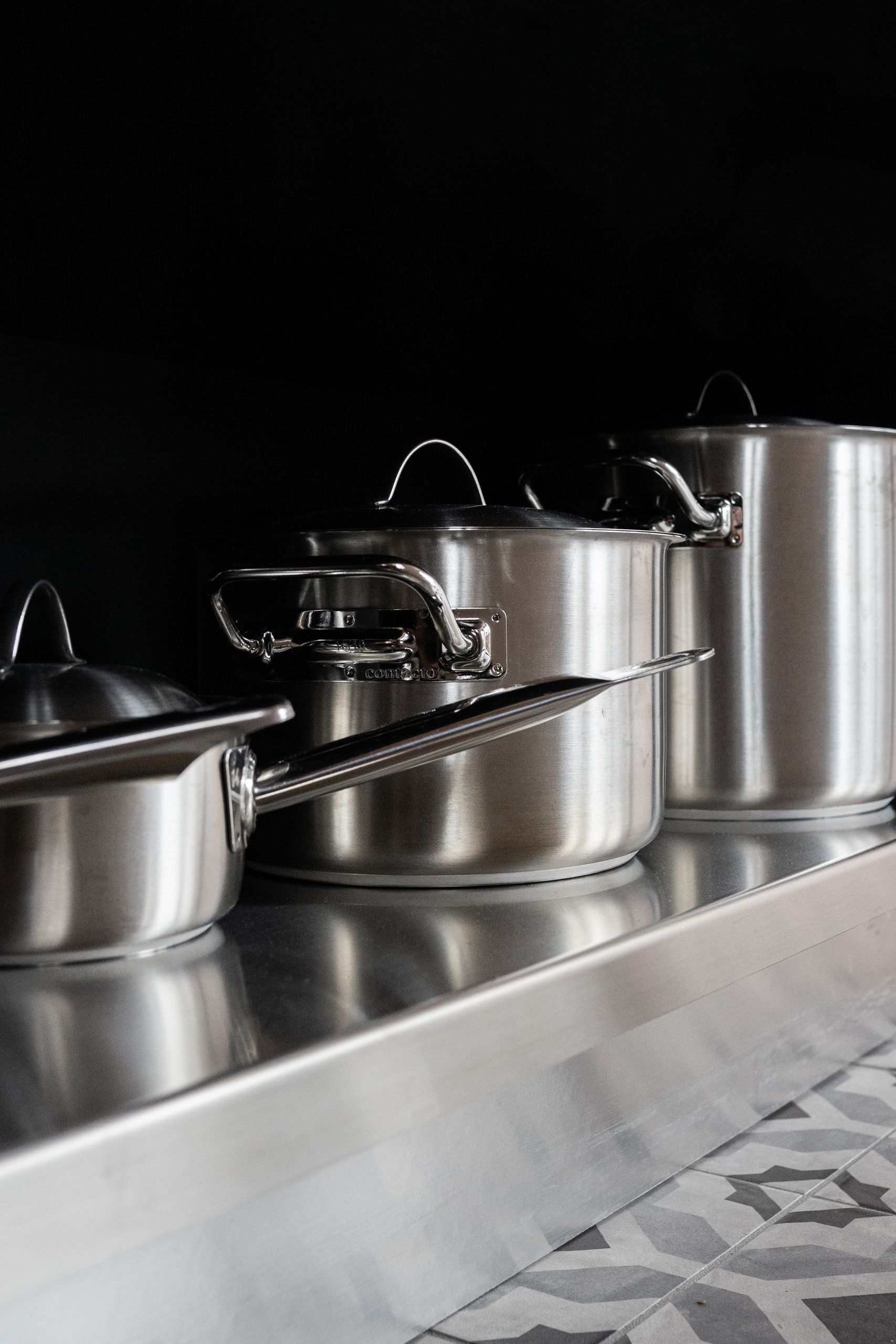

How Do 360 Cookware and Heritage Steel Actually Cook?
| Cooking task | My pick | Why |
|---|---|---|
| Searing | Heritage Steel | Excellent heat retention without 360’s higher price |
| Eggs & delicate foods | Heritage Steel, slightly | Easier handling, but both still require stainless steel technique |
| Sauces & simmering | Heritage Steel | Better fit for traditional temperature control and reductions |
| Vapor / low-water cooking | 360 Cookware | This is what its fitted lid system is designed for |
| Induction | Tie | Both have magnetic stainless exteriors |
| Oven & broiler | Heritage Steel | 800°F and broiler-safe vs. 360’s 500°F rating |
| Handling | Heritage Steel overall | 360 has the better grip, but some pieces are extremely heavy |
| Cleaning | Heritage Steel, slightly | Both are best hand washed, but 360’s exposed rim adds another consideration |
There is no dramatic performance loser here.
Both are substantial stainless steel pans that hold heat well. Neither behaves like lightweight cookware, and neither should be expected to release eggs the way PTFE nonstick does.
The bigger difference is how you want to cook.
360 Cookware Review
What I Like About 360 Cookware
The reason to buy 360 is its Vapor Cooking system.
Its fitted lids hold onto moisture especially well, allowing foods like vegetables, chicken, rice, braises, and one-pot meals to cook with very little added water and relatively low heat.
360 also holds heat very well, which is useful for browning meat and maintaining an even cooking temperature.
What I Don’t Love
The biggest drawback is weight.
An independently tested 3.5-quart sauté pan weighed about seven pounds before food was added. That is a lot of pan.
360 also tends to respond more slowly when you change burner temperature.
And the price is hard to ignore, especially with pieces such as the 10-inch fry pan. It costs more than the comparable Heritage skillet but does not use the Vapor system because 360’s fry pans are not designed for lids.
Vapor Cooking also takes a little practice. Too much heat, repeatedly lifting the lid, or not having enough moisture in the pan can interfere with the process.
360 is best for you if:
💧 You genuinely want to use Vapor Cooking
🍗 You make lots of vegetables, chicken, braises, roasts, rice, or covered meals
🔥 You prefer cookware with strong heat retention
💪 Heavy cookware does not bother you
🧼 You do not mind hand washing
💰 You are comfortable paying extra for 360’s specific cooking system
If I were simply buying a great stainless frying pan, 360 would not be my first choice.

Pros
- T-316 stainless steel cooking surface
- No PFAS/PTFE nonstick coating
- Made in Wisconsin with global materials
- Excellent heat retention
- Unique Vapor Cooking system
Cons
- Higher price than many premium stainless sets
- Some pieces are very heavy
- Vapor Cooking has a learning curve
Heritage Steel Review
For this comparison, I am using Heritage Steel’s Titanium Series.
Heritage also makes the less expensive Eater Series, which uses 304 stainless steel rather than 316Ti. Both are fully clad and 5-ply.
If you do not particularly care about having a 316Ti cooking surface, the Eater Series is also worth a look.
What I Like About Heritage Steel
Heritage feels much more like a traditional premium stainless cookware purchase.
You get the 316Ti cooking surface, three internal aluminum layers, good heat retention, induction compatibility, and an 800°F oven rating with broiler compatibility.
Independent testing found very even cooking with steak, salmon, chicken, vegetables, eggs, and sauces.
I also like the rounded pouring rims. It sounds like a tiny detail until you try to pour a pan sauce out of cookware that doesn’t have one.
Skillet lids are available too, which gives Heritage’s fry pans more flexibility than 360’s lidless fry pans.
And then there is the price.
Heritage simply costs less in the comparable sizes I checked.
What I Don’t Love
The polished Titanium finish can show fingerprints, scratches, and rainbow heat tint fairly easily.
None of that damages the cookware. It just will not remain showroom-perfect forever.
Heritage Steel is best for you if:
🍳 You want premium everyday stainless steel cookware
🔥 You sear or use the broiler regularly
⚡ You cook on induction
🥘 You want traditional stainless cooking without learning a special system
💪 You want substantial cookware without 360’s extreme weight
💰 You care about getting the better value
🇺🇸 U.S. manufacturing matters to you

Pros
- 316Ti stainless steel cooking surface
- No PFAS/PTFE nonstick coating
- 5-ply fully clad construction
- Oven-safe to 800°F and broiler-safe
- Excellent heat retention
- Made in Tennessee with global materials
Cons
- Polished finish shows marks easily
- Hand washing recommended
Cleaning, Durability, and Everyday Use
Both brands are bare stainless steel, so neither has a nonstick coating that eventually needs to remain intact.
Scratches, swirls, fingerprints, and rainbow heat tint are normal cosmetic changes.
Food can also stick to either one if the pan is too hot, too cold, or food is moved before it naturally releases.
Dishwasher use
I would hand wash both.
Heritage recommends hand washing because some dishwasher detergents can be corrosive.
360 is an even clearer hand-wash situation for me. Some of its product pages call the cookware dishwasher-safe, while its care and warranty information warns that alkaline dishwasher detergents can damage the exposed aluminum along the rim.
That contradiction is enough for me to keep it out of the dishwasher.
Weight
Heritage is easier to handle overall.
360’s substantial weight may appeal to someone who loves very heavy cookware, but I would think carefully before buying the larger pieces if grip strength or lifting heavy pans is an issue.
Made in USA and Warranty
Both companies manufacture cookware in the United States using some globally sourced materials.
360 Cookware
360 forms, finishes, assembles, inspects, and packs its cookware in West Bend, Wisconsin.
Its clad metal comes from South Korea, and some components are imported.
The company accurately describes the cookware as Made in the USA with Global Materials.
Heritage Steel
Heritage manufactures its cookware and lids in Clarksville, Tennessee.
Its materials are also sourced both domestically and internationally, including clad steel from South Korea.
Heritage likewise uses the qualified Made in USA with Global Materials wording.
What about the warranties?
Both offer lifetime warranties against manufacturing defects.
There are normal exclusions for things like misuse, overheating, scratches, and cosmetic wear.
The main details I would remember:
I would register Heritage immediately and save proof of purchase for either brand.
Warranty winner: Tie.
Price: Is Heritage Steel or 360 Cookware the Better Value?
This is where Heritage pulls ahead for me.
I compared regular prices rather than temporary sales.
| Comparable piece | 360 Cookware | Heritage Titanium |
|---|---|---|
| 10-ish inch fry pan | $189.95 | $149.95 |
| 2-quart saucepan | $219.95 | $209.95 |
| 3.5 to 4-quart sauté pan | $279.95 | $249.95 |
| Comparable cookware set | $1,235 | $949.95 |
Prices checked July 2026. Promotions can change, so check the current brand pricing before buying.
The fry-pan comparison is particularly interesting.
Heritage’s 10.5-inch skillet costs about $40 less, and Heritage also offers that skillet with a stainless lid for roughly the same price as 360’s lidless 10-inch fry pan.
What about the sets?
Both of the sets I compared contain five actual cooking vessels.
360’s Home Chef Set includes four lids, while Heritage’s Titanium 10-Piece Set includes five.
Heritage also gives you an 8-quart stockpot instead of 360’s 6-quart pot.
360’s set does include a slow-cooker base, which is genuinely useful if that feature appeals to you.
Still, for a full stainless cookware replacement, I prefer the Heritage Steel set.
🏆 Best value: Heritage Steel Titanium Series
360’s price makes much more sense if you specifically want the Vapor Cooking system.
If you are going to use both brands like ordinary stainless cookware, I would save the money and buy Heritage.
Which Should You Buy?
This is how I would make the decision.
💧 Choose 360 Cookware if:
🍳 Choose Heritage Steel Titanium Series if:
🏆 My Pick: Heritage Steel Titanium Series
Heritage is the cookware I would recommend to most people.
It gives you strong materials, excellent everyday performance, greater oven versatility, and lower prices.
360 is more specialized. I would choose it specifically for Vapor Cooking, not because I think its stainless steel construction is categorically better.
Pros
- 316Ti stainless steel cooking surface
- No PFAS/PTFE nonstick coating
- 5-ply fully clad construction
- Oven-safe to 800°F and broiler-safe
- Excellent heat retention
- Made in Tennessee with global materials
Cons
- Polished finish shows marks easily
- Hand washing recommended
Pros
- T-316 stainless steel cooking surface
- No PFAS/PTFE nonstick coating
- Made in Wisconsin with global materials
- Excellent heat retention
- Unique Vapor Cooking system
Cons
- Higher price than many premium stainless sets
- Some pieces are very heavy
- Vapor Cooking has a learning curve
Are 360 Cookware and Heritage Steel Non-Toxic?
Both cookware lines fit the material standards I look for: bare cooking surfaces, no PFAS/PTFE nonstick coating, no ceramic-style nonstick coating, and no exposed aluminum cooking surface.
Both also contain aluminum inside the clad body and nickel in the stainless steel alloy, which is normal for this type of cookware.
For me, both are strong coating-free options. The buying decision comes down much more to how you cook, how heavy you like your pans, and what you want to spend.
You may also find these Posts helpful
find your next kitchen swap
Frequently Asked Questions
Final Verdict
For most people, I would buy Heritage Steel Titanium Series.
Choose 360 if the Vapor Cooking system genuinely appeals to you. Otherwise, Heritage gives you excellent stainless steel performance, better high-heat versatility, and a lower price.