For most home cooks, the single most important thing to know about stainless steel cookware grades is this: construction drives cooking performance more than the grade number stamped on the box. An 18/10 (SAE 304) interior with a full-clad aluminum core in a tri-ply pan is widely considered a good balance of price, performance, and corrosion resistance for everyday cooking. Five-ply can improve heat evenness on heavy-duty ranges, but a well-built 3-ply often outperforms a thin, poorly bonded 5-ply.
Here’s what to look for at a glance:
What do stainless steel cookware grades actually mean?
The numbers stamped on your cookware (18/10, 18/8, 18/0) are marketing shorthand, not independent metallurgical standards. Both 18/8 and 18/10 commonly map to SAE 304, the workhorse alloy of the 300 series. In practice, a manufacturer may sell the same SAE 304 steel as either “18/8” or “18/10” depending on where the nickel content falls within the alloy’s allowable range. The SAE or ASTM grade number (304, 316, 430) is a more reliable indicator of what’s actually in your pan than the 18/x stamp.
The three series you’ll encounter in cookware
| Series | Common Grades | Nickel | Magnetism | Typical Use |
|---|---|---|---|---|
| 200 series | 201, 202 | Low (manganese substituted) | Usually nonmagnetic; forming can increase magnetism | Budget cookware; avoid |
| 300 series | 304, 316 | Varies by grade; generally higher in 316 than 304 | Nonmagnetic (austenitic) | Quality cookware interiors |
| 400 series | 430 (ferritic) | No intentionally added nickel | Magnetic | Induction exteriors; 18/0 pans |
200 series steels swap nickel for manganese to cut costs. Food & Wine recommends looking for 300-series interiors specifically because 200-series alloys are more prone to corrosion and are a common marker of cheap cookware.
SAE 304 (sold as 18/8 or 18/10) is the standard for quality cookware interiors.
SAE 316 adds molybdenum for greater corrosion resistance, particularly against chlorides found in salt. It offers an extra margin of durability, but 304 is already a strong choice for everyday home cooking.
430 (18/0) contains no intentionally added nickel and is ferritic, meaning it’s magnetic. That makes it the go-to material for induction-compatible exteriors. It’s less corrosion-resistant than 304, so you’ll rarely see it used for the interior cooking surface of quality pans.
A note on nickel allergies: People with severe nickel sensitivities sometimes react to 304 or 316 cookware. If that’s a concern in your household, 18/0 (430) pans avoid intentionally added nickel, though they trade some corrosion resistance to do it.
How to check stainless steel cookware grades and construction
Knowing what to look for before you buy (or in a pan you already own) saves a lot of guesswork.
- Check the stamping or packaging label. Quality manufacturers stamp the grade directly on the pan or list it clearly on the box: “18/10,” “304,” “316,” or “tri-ply full-clad.” If the label just says “stainless steel” with no further detail, that’s a signal the manufacturer isn’t proud of the alloy.
- Use a magnet to check the base for induction compatibility. A firm attraction is a useful sign, but check the manufacturer’s induction rating too. A magnet cannot reliably identify the cooking-surface grade: 200-series steel can also be nonmagnetic, forming can make some 304 steel magnetic, and a clad pan’s magnetic outer layer can affect the result.
- Weigh the pan. Heavier pans generally indicate thicker layers and a more substantial core, which lowers the risk of warping. A 10-inch skillet that feels flimsy and unusually light may be a warning sign.
- Read the spec page for construction terms. Look for: full-clad (not just disc-bottom), the core material (aluminum or copper), and the number of plies. If a brand lists exact grades (304, 316) and describes its cladding method, that transparency is a positive signal of manufacturing quality.
3-ply vs. 5-ply: what actually changes for you?
“Ply” refers to the number of bonded metal layers in a pan’s construction. A tri-ply pan has three layers (typically stainless/aluminum/stainless), and a 5-ply has five (often stainless/aluminum/stainless/aluminum/stainless, or variations with a copper layer). Here’s the part that surprises most shoppers: more layers don’t automatically mean better performance. Materials-science reporting confirms that full-clad cores and manufacturing quality matter more than simply increasing ply count.
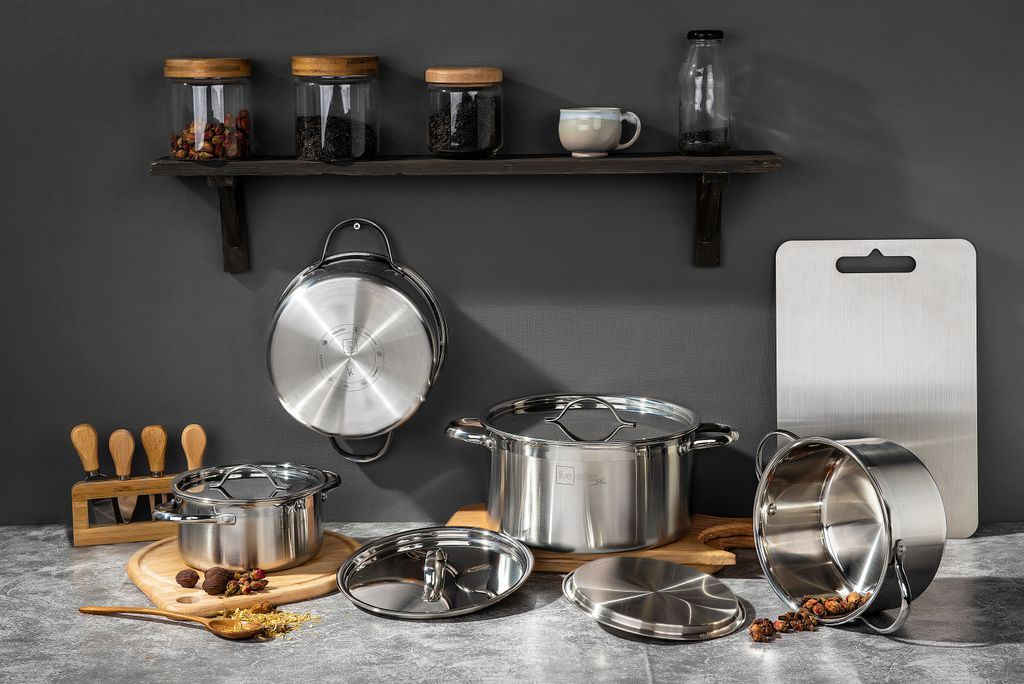
What actually determines performance is the thickness and quality of the core, how well the layers are bonded, and whether the cladding runs all the way up the sidewalls (full-clad) or only covers the base (disc-bottom).
What matters more than the number of layers
Ply count alone cannot tell you whether a pan heats faster, weighs more, holds heat longer, or resists warping better. Those differences depend on the materials, their thickness, and the overall build.
360 Cookware uses tri-ply construction, while Heritage Steel uses five layers, including three aluminum layers between stainless steel surfaces. Both approaches can produce excellent cookware. The layer count alone does not establish which pan has a thicker core or responds faster to temperature changes.
For a closer look at how those differences affect everyday cooking, see my 360 Cookware vs. Heritage Steel comparison, including materials, handling, price, and which one I would choose.
My buying advice: Compare the specific pans, including their dimensions, construction details, weight, and handling. More layers are not automatically worth a higher price.
Why full-clad construction matters more than the grade number
The cooking surface grade (304 vs. 316) affects corrosion resistance and nickel content. The construction, specifically whether the conductive core runs up the sidewalls or only sits under the base, determines how your food actually cooks.
Full-clad cookware carries its conductive core through the base and sidewalls, which is useful for cooking along the whole surface. Disc-bottom cookware concentrates that conductive material beneath the base. A well-designed, thick disc can distribute heat very evenly, so disc-bottom construction is not automatically a sign of poor performance.
Aluminum core vs. copper core: the practical difference
| Core material | Thermal conductivity | Responsiveness | Cost | Best for |
|---|---|---|---|---|
| Aluminum | High | Fast | Moderate | Everyday cooking, sautéing, weeknight meals |
| Copper | Very high | Very fast | High | Precision cooking, professional techniques |
You may also find these Posts helpful
find your next cookware swap
Which stainless steel cookware grades suit your cooking style?
| Use case | Recommended grade | Recommended construction |
|---|---|---|
| Everyday sautéing and weeknight cooking | 18/10 (SAE 304) interior | Full-clad tri-ply, aluminum core |
| Searing and high-heat cooking | 18/10 (SAE 304) interior | 5-ply or thick tri-ply, full-clad |
| Induction cooktops | 18/10 interior + 18/0 or 430 exterior | Full-clad with magnetic base layer |
| Saltwater, brining, high-acid cooking | SAE 316 interior | Full-clad, any ply count |
| Oven use and high-heat baking | 18/10 (SAE 304) | Check oven-safe temp rating; rivet and handle quality matter |
For oven use, check the manufacturer’s temperature limits for the pan, handles, and lid. Both riveted and properly welded handles can be durable; secure construction matters more than the attachment method alone.
For induction cooking specifically, the exterior layer needs to be magnetic. Most quality full-clad pans solve this by using a 430 (ferritic) exterior layer bonded to the 304 interior. You get the corrosion resistance of 304 on the cooking surface and the induction compatibility of 430 on the base.
Ready to compare actual pans? My non-toxic cookware buying guide brings together the sets I recommend across different materials and budgets.
Is stainless steel cookware safe? What you need to know about nickel and reactivity
Uncoated stainless steel is generally suitable for everyday cooking, including acidic foods. It can release some nickel and chromium, with the amount depending on the cookware, food, and cooking time. Research on stainless steel pots under common cooking conditions supports their suitability for most people, while recognizing that particularly sensitive individuals may need additional precautions.
Safety note: An uncoated stainless steel cooking surface does not need a PFAS or PTFE nonstick coating. Check the actual cooking surface when shopping, since some pans marketed as stainless steel or “hybrid” also include a nonstick coating.
Pro Tip: After cooking acidic foods (tomatoes, wine-based sauces, citrus), rinse and dry the pan promptly rather than letting it soak. This is the single easiest way to protect the surface and minimize any metal-food interaction.
Still deciding whether stainless steel is right for your kitchen? My ceramic vs. stainless steel cookware comparison covers the differences in food release, durability, maintenance, and everyday cooking.
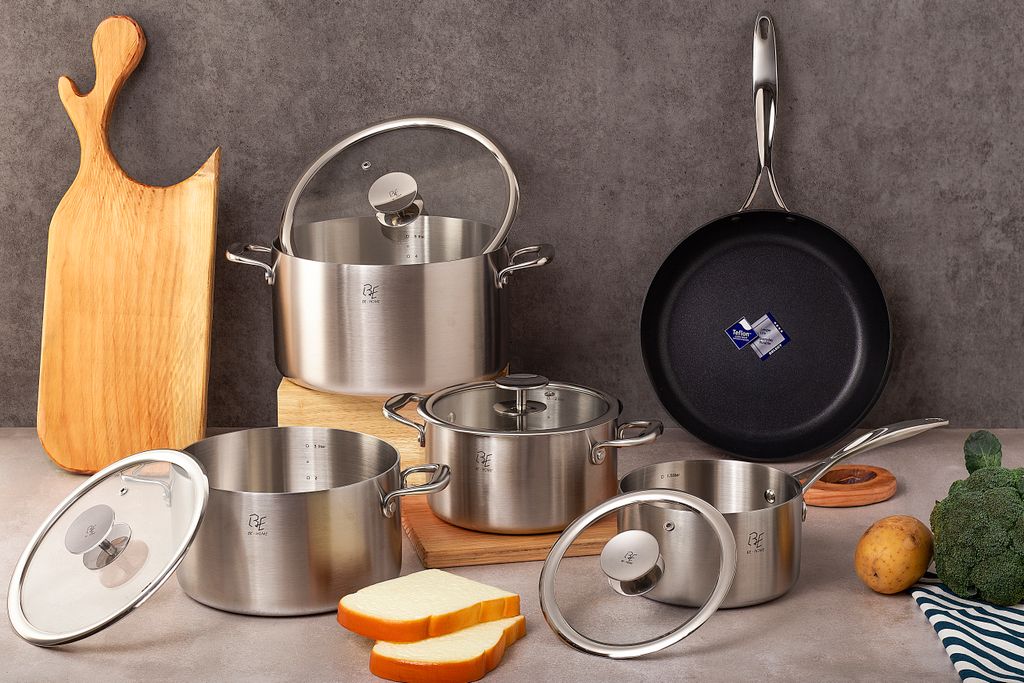
How to care for stainless steel cookware so it lasts
Stainless steel cookware grades help explain corrosion resistance, but proper care matters too. These simple habits protect the surface and keep your pans performing well for years.
- Preheat before adding oil. A properly preheated stainless pan is far less prone to sticking and easier to clean. Heat the pan over medium until a drop of water beads and rolls (the Leidenfrost effect), then add oil.
- Hand-wash when possible. Dishwashers won’t ruin a quality 304 pan, but the harsh detergents and high heat cycles accelerate surface dulling and can loosen rivets over time. A quick hand-wash with warm water and a non-toxic dish soap is gentler and faster.
- Use a non-abrasive scrubber for daily cleaning. A soft sponge or nylon brush handles most residue. For stuck-on food, deglaze with warm water while the pan is still warm (not boiling hot).
- Dry immediately after washing. Water spots and mineral deposits from hard water come from letting pans air-dry. A quick towel-dry prevents both.
Do not:
Pro Tip: White mineral deposits from hard water dissolve easily with a solution of equal parts white vinegar and water. Simmer it in the pan for two to three minutes, let it cool, then rinse. No scrubbing needed.
Frequently Asked Questions
More Cookware Guides


Sources
- British Stainless Steel Association: Selection of Stainless Steels for the Food Processing Industries. Technical guidance on 304, 316, and 430 stainless steel, their suitability for food contact, and how salt, acidity, and surface condition affect corrosion.
- Outokumpu: Handbook of Stainless Steel. A technical reference covering stainless steel grades, alloy composition, physical properties, corrosion resistance, and manufacturing methods.
- Carpenter Technology: Magnetic Properties of Stainless Steels. Explains the magnetic behavior of different stainless steel families, including why forming can make some 304 steel magnetic and why a magnet alone cannot identify the exact grade.
- Kamerud et al. (2013), Journal of Agricultural and Food Chemistry: Stainless Steel Leaches Nickel and Chromium into Foods During Cooking. Research examining how steel grade, cooking duration, and repeated use affect nickel and chromium release into tomato sauce.
- Guarneri et al. (2017), Contact Dermatitis: Release of Nickel and Chromium in Common Foods During Cooking in 18/10 (Grade 316) Stainless Steel Pots. Research on metal release under everyday cooking conditions, with consideration of people who are particularly sensitive to nickel or chromium.