When a glass air fryer is marketed as “PFAS-free,” that claim almost always refers to the glass cooking vessel itself, not the entire appliance. The glass bowl is inherently free of PTFE, PFOA, and related per- and polyfluoroalkyl substances because glass is a non-porous, inert material that requires no synthetic coating.
But the crisper plate sitting inside that bowl, the silicone seals around the lid, and the plastic housing on the heating pod? Those parts may tell a different story.
Here is what you can generally count on, and what still needs a closer look:
The bottom line: A “PFAS-free” label on a glass air fryer is usually a claim about the bowl, not a whole-unit certification. Before you buy, pull up the spec sheet and verify materials for every part that touches your food.
Your clearest next step is to search the product page for a part-level materials list or contact the manufacturer’s support team directly and ask which specific components are PFAS- and PTFE-free.
Key Takeaways
A “PFAS-free” label on a glass air fryer covers the glass vessel by default, but the crisper plate, lid seal, and rack require separate verification before you can trust the full unit is free of synthetic coatings.
| Point | Details |
|---|---|
| PFAS-free scope | The claim covers the glass bowl; crisper plates, seals, and racks need separate confirmation. |
| Borosilicate advantage | Borosilicate glass is inherently coating-free, dishwasher-safe, and thermal-shock resistant within manufacturer limits. |
| Wattage determines crisping | Models at 1,700W or higher deliver reliable crisping; lower-wattage glass units may underperform on dense foods. |
| Verification step | Request part-level materials specs or a third-party lab report that names each food-contact component tested. |
What a PFAS-free claim actually covers in a glass air fryer
“PFAS-free” sounds like a blanket guarantee, but in practice it is a narrowly scoped statement. Good Housekeeping’s kitchen lab found that “PFAS-free” descriptions typically refer to the glass cooking vessel and advised checking part-level disclosures because components like crisper plates or lids can still have coatings.
Glass is PFAS-free by material composition. It does not need a nonstick coating to release food, so there is nothing to apply and nothing to chip off into your dinner. That is a genuinely meaningful advantage over traditional metal-basket air fryers, where worn PTFE coatings can flake over time. CNET’s testing notes that the shift to glass is driven by consumers wanting to avoid nonstick coatings that can chip or release synthetic chemicals, and that glass bowls are non-porous and do not degrade the way chemical nonstick surfaces do.
Where the claim gets murky is everywhere else. Common misunderstandings include:
Pro Tip: The exact phrasing on a spec sheet matters. “Glass vessel free of PFAS” is a much narrower claim than “entire unit PFAS-free.” Read it word for word before drawing conclusions.
Which parts you must verify before trusting a PFAS-free claim
Not every part of a glass air fryer carries the same risk level. The table below maps the most common components to their likely material and where PFAS exposure risk may still exist.
| Component | Likely Material | PFAS Risk Level | What to Check |
|---|---|---|---|
| Glass cooking bowl | Borosilicate glass | Low (inherently PFAS-free) | Confirm borosilicate; ask if any coating is applied |
| Crisper plate / basket insert | Metal with ceramic or PTFE coating | Moderate to High | Request explicit PTFE/PFAS-free confirmation |
| Silicone lid seal | Food-grade silicone | Low to Moderate | Ask if silicone meets FDA food-contact standards |
| Lid (if plastic or composite) | Polycarbonate or ABS plastic | Moderate | Check for BPA-free and phthalate-free disclosure |
| Wire rack | Stainless steel or coated steel | Low to Moderate | Confirm no PTFE coating on rack surface |
| Heating pod housing | Plastic / electronics | Low (not food-contact) | Less critical, but note it is outside any PFAS-free claim |
| Handles | Plastic or silicone | Low | Verify BPA-free if plastic |
Quick checks to run on each part:
The parts most commonly left undisclosed are the crisper plate coating and the lid material. These are also the parts most likely to contact food directly, which makes the omission worth pushing back on with the manufacturer.
How glass changes cooking performance, cleaning, and safety
The visible-cooking advantage is real and underappreciated. Because the bowl is transparent, you can watch browning happen without opening the unit, which means no heat loss and no guesswork about whether your chicken thighs need another two minutes. CNET’s testing specifically highlights this: transparent vessels eliminate repeated interruptions that can affect final texture.
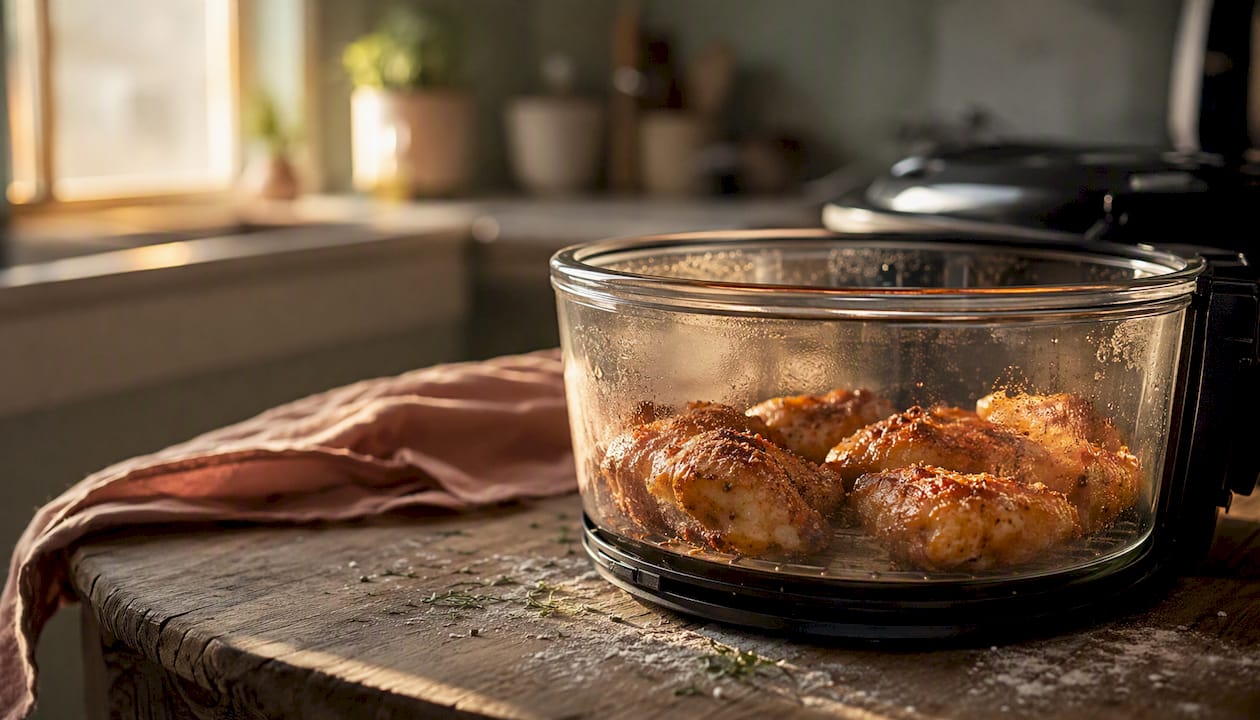
Cleaning is genuinely easier. Glass is non-porous, so oils and food residue do not soak in. Most glass vessels are dishwasher-safe, and there is no coating to baby. You can also use the glass bowl as a storage container after cooking, which cuts down on dishes.
On performance: Wattage matters more than the vessel material. Reviewers at KTSM caution that not all glass models reach the same crisping performance, and that wattage and airflow design are the deciding factors. High-wattage glass models in the 1,785–2,050W range can crisp comparably to metal-basket units. Lower-wattage glass models may produce softer results, especially with dense or high-moisture foods.
On thermal shock: Most glass air fryer vessels use borosilicate glass, which is engineered for temperature resistance. SharkNinja’s product documentation markets these containers as going from fridge to fryer, and reviewers confirm that thermal-shock resistance reduces breakage risk significantly. It does not eliminate it. Never move a glass vessel directly from a freezer to a preheated unit, and always follow the manufacturer’s stated temperature-change limits.
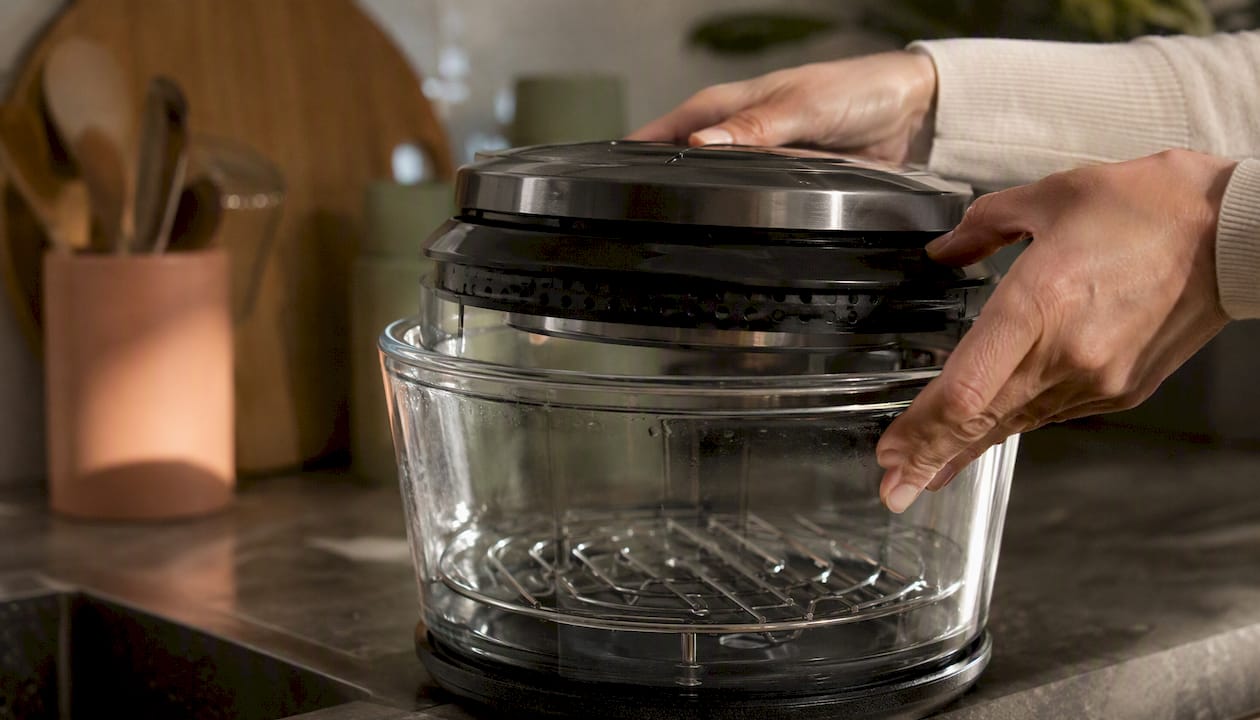
Modular designs (where the heating pod separates from the glass bowl) let you store the glassware in a cabinet and keep only the pod on the counter. CNET highlights this as a real storage advantage over fixed-basket units.
Trade-offs at a glance:
How to verify a PFAS-free claim before you buy
Manufacturer marketing copy is not evidence. Here is a step-by-step process to get answers you can actually trust.
I did exactly this for my best non-toxic air fryers guide, emailing every manufacturer on my shortlist about its food-contact materials and coatings. I included the useful answers in the guide, too. Want to guess which brand gave me the runaround instead of a straight materials list? I named it in the guide.
Pros and cons of glass air fryers vs. traditional basket-style models
| Factor | Glass air fryer | Traditional basket air fryer |
|---|---|---|
| PFAS exposure (vessel) | Low: glass is inherently coating-free | Higher risk: PTFE-coated baskets common, especially in budget models |
| PFAS exposure (accessories) | Varies: crisper plate may still be coated | Varies: same risk on basket inserts |
| Cleaning | Dishwasher-safe glass bowl; no coating to protect | Basket often hand-wash recommended to preserve coating |
| Cooking visibility | High: watch browning in real time | Low: must open unit to check |
| Storage | Glass bowl doubles as food storage container | Basket stays in unit; no storage function |
| Weight and fragility | Heavier; breakage risk if dropped | Lighter; more durable under rough handling |
| Crisping performance | Strong at high wattage; variable at lower wattage | Consistently strong across wattage ranges |
| Price | Wide range; budget options widely available | Wide range; budget options widely available |
| Replacement parts | Glass vessels often sold separately | Baskets available but coating degrades over time |
The PFAS-related advantages are concentrated in the vessel column. If your primary concern is avoiding a degrading nonstick coating inside the cooking chamber, glass addresses that directly. The crisper plate caveat applies to both categories, so the comparison on that point is roughly even unless you specifically verify the plate material for each model.
Magnifique vs. Ninja Crispi: my quick take
If you are deciding between two recognizable modular glass air fryers, Magnifique is my pick for a non-toxic kitchen. Both use borosilicate glass cooking vessels, but the Magnifique Air Crisper pairs its glass bowls with an uncoated stainless steel crisper disk. The Ninja Crispi uses an aluminum crisper plate with a nano-ceramic coating, which does not meet the stricter materials standard I use for my top recommendations.
The Ninja has some convenience and performance advantages, but I prefer Magnifique’s simpler food-contact materials. My full Magnifique vs. Ninja Crispi comparison breaks down the materials, controls, capacity, cleaning, and trade-offs side by side.
Quick buying checklist for a non-toxic glass air fryer
Before you add anything to your cart, run through these:
Must-have disclosures:
Red flags:
Practical shopping tips:
Pro Tip: If you are comparing glass air fryer options and want a guide that has already done the part-level materials research, the best non-toxic air fryers guide at Naturally Non-Toxic covers verified disclosures and model testing summaries rather than marketing claims.
What testing and expert sources say about glass vessels
Kitchen testing teams consistently confirm the visible-cooking and cleaning advantages of glass. Good Housekeeping’s lab found that glass is dishwasher-safe, lets you watch browning, and avoids the nonstick flaking concern. CNET’s reviewer who tested 20 air fryers called a glass model the one they recommend most for non-toxic cooking, citing the modular design and multiple glassware sizes as practical advantages beyond the PFAS-free vessel.
On crisping, the evidence is more nuanced. KTSM reviewers found that not all glass models reach the same crisping performance, with wattage and airflow design being the key variables. High-wattage glass models perform comparably to metal-basket units; lower-wattage models may not.
On thermal shock, SharkNinja’s documentation confirms borosilicate construction and fridge-to-fryer capability, and independent reviewers echo that the risk is manageable when you follow manufacturer guidance.
Where evidence is weaker: independent lab testing of specific glass air fryer models for PFAS across all parts is not widely published. Most “PFAS-free” claims in this category rest on manufacturer declarations rather than third-party analytical chemistry reports. That gap is worth acknowledging.
Pro Tip: When reading a test report or manufacturer declaration, look for these specifics: which parts were tested (not just “the unit”), the lab’s name, and the limits of detection used. A report that says “no PFAS detected” without stating the detection threshold is less informative than one that says “below X parts per trillion across all food-contact surfaces.”
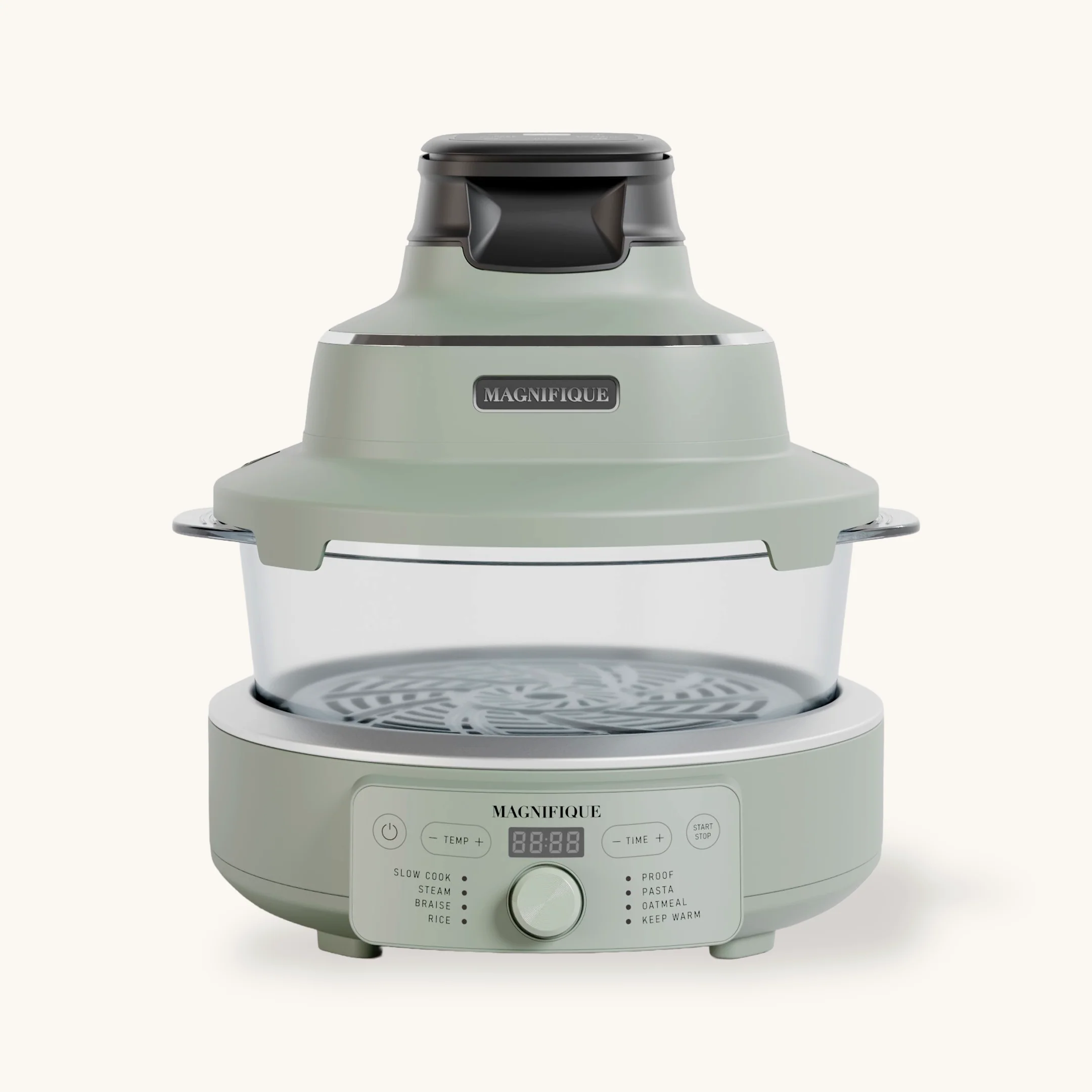
My top overall pick for a non-toxic air fryer, largely because of its excellent food-contact materials. The Magnifique Combo uses a borosilicate glass cooking pot and lid with a stainless steel crisper plate, avoiding the coated cooking baskets found in most conventional air fryers. It also works as a multi-cooker, giving you air frying, slow cooking, steaming, braising, rice cooking, and more in one appliance.
Best for: Anyone prioritizing the cleanest food-contact materials without giving up everyday versatility.
Pros: Borosilicate glass pot and lid • Stainless steel crisper plate • No traditional nonstick coating • Minimal plastic food contact • Air fries and slow cooks • Multiple cooking modes • One appliance can replace several others
Cons: More components than a basic air fryer • Smaller air-frying area than a full countertop oven • Glass cooking vessel is heavier • Higher price than a basic basket model
Why scope clarity matters more than the label itself
The “PFAS-free” label on a glass air fryer is doing a lot of marketing work for a fairly narrow material claim. Glass is genuinely a safer vessel choice, and that matters, especially for parents replacing a worn, scratched nonstick basket. But the label has become a shorthand that consumers reasonably, and incorrectly, extend to the whole appliance.
What actually protects your family is not the label. It is the habit of asking which parts are covered, requesting the documentation, and knowing that a crisper plate with an undisclosed coating is a real gap in an otherwise clean setup. The glass bowl is a great start. It is not the finish line.
Good Housekeeping notes that switching to glass is most motivated when buying new or replacing a worn unit, not necessarily as an urgent upgrade from a well-maintained existing air fryer. That framing is useful: glass air fryers are a meaningful step toward lower chemical exposure in the kitchen, but the step is only as solid as the full materials picture you verify before buying.
To triangulate any model’s claims, cross-reference the manufacturer’s product page (for stated specs), an independent testing outlet like Good Housekeeping or CNET (for real-world performance), and any available third-party lab report (for chemical verification). No single source covers all three.
Frequently Asked Questions
Recommended