Hard maple is a strong all-purpose cutting board material: it’s durable, comfortable to chop on, and gentle on knife edges. For a kitchen with less plastic, a well-made hardwood board is a practical starting point. Keep a separate board for raw meat, poultry, and seafood. USDA guidance allows wood or nonporous materials for these foods, provided they’re cleaned properly.
Here’s how to match cutting board material to each cooking task:
Key Takeaways
Choose a durable board you can clean properly, and keep raw-meat preparation separate from produce and ready-to-eat foods.
| Point | Details |
|---|---|
| Best overall material | Hard maple (end-grain or edge-grain) balances knife-friendliness, sanitation, and durability for daily prep. |
| Raw meat rule | Use a separate titanium board for raw meat, poultry, and seafood. Wash and sanitize after use, and check that your knives are suitable for metal cutting surfaces. |
| Maintenance priority | Oil hardwood boards monthly with food-grade mineral oil; dry upright after every wash to prevent warping. |
| Verify finish and adhesives | Look for named food-safe ingredients (food-grade mineral oil, NSF/FDA language) — “natural” alone is not enough. |
How do the best cutting board materials compare at a glance?
| Material | Main advantage | Main drawback | Care |
|---|---|---|---|
| Hard maple | Durable, forgiving everyday cutting surface | Requires maintenance | Hand wash; condition as directed |
| Walnut or cherry | Comfortable for prep and attractive for serving | Softer wood can show cuts more readily | Hand wash; condition as directed |
| Bamboo | Affordable and lightweight | Can be harder on knife edges; construction varies | Hand wash |
| Glass or stone | Useful for serving or pastry work | Unforgiving on knife edges | Product-specific care |
| Stainless steel or titanium | Nonporous metal surface | Potential knife wear and slipping | Product-specific care |
A few trade-offs worth flagging:
Why solid hardwoods are still the top choice for most kitchens
Hard maple, walnut, cherry, and beech are widely recommended by woodworkers and chefs because closed-grain hardwoods resist moisture absorption and are gentle enough on knife edges to reduce frequent sharpening.
Pros:
Cons:
Janka hardness and what it means for your knives
Janka hardness measures resistance to denting. It helps compare woods, but it does not establish a universal knife-safe range.
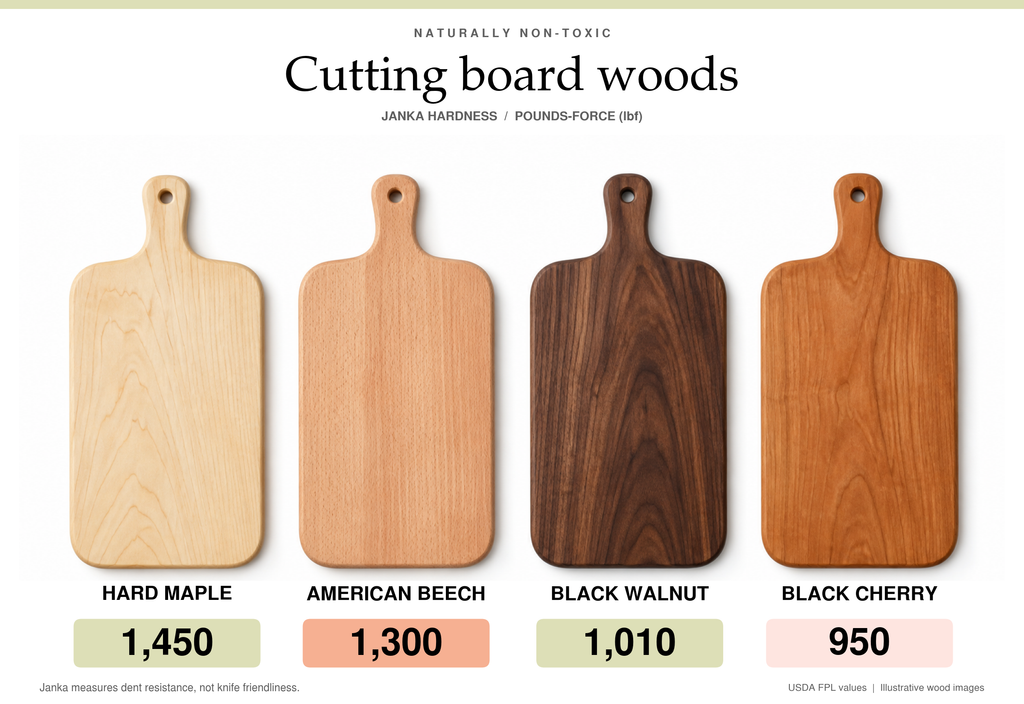
Walnut and cherry have lower Janka ratings than hard maple and American beech, so they dent more easily. These numbers describe the wood’s resistance to denting, not how quickly it will dull a knife. Board construction and cutting technique matter too.
End-grain vs. edge-grain vs. face-grain
The cut of the wood matters almost as much as the species. End-grain boards (where the knife hits the ends of the wood fibers) are the gentlest on blades because the edge slips between fibers rather than cutting across them. They also self-heal better. Edge-grain boards (the long face of the plank) are more affordable and still excellent. Face-grain boards (the flat, wide face) look beautiful but scar more easily and are better suited to serving than heavy chopping.

Pro Tip: Oil a new hardwood board three to five times in its first week before use, then settle into a monthly routine for high-use boards. To remove odors, scrub with coarse salt and half a lemon, let it sit for two minutes, then rinse and dry immediately.
Is bamboo actually a good cutting board material?
Bamboo gets marketed as the eco-friendly, sustainable alternative to wood, and the sustainability angle has some truth to it — bamboo is a fast-growing grass, not a slow-growth hardwood. But the kitchen performance story is more complicated.
Bamboo is typically harder than hard maple, which sounds like a durability win but actually means it’s tougher on knife edges. Bamboo’s hardness makes it more likely to dull blades faster than a properly selected hardwood. The surface also tends to splinter with heavy use, and many budget bamboo boards use adhesives to laminate the strips together. The food-safety of those glues varies by manufacturer.
Pros:
Cons:
Pro Tip: Before buying a bamboo board, check the product page for the specific glue or adhesive used in lamination. Look for “food-safe” or “FDA-compliant adhesive” language. If the listing just says “eco-friendly glue” with no further detail, that’s a red flag worth skipping.
Bamboo is a reasonable budget pick for light prep work. Slicing fruit, cutting bread, prepping vegetables. For frequent chopping, I prefer a well-made hardwood board. For a dedicated raw-meat surface, titanium offers a plastic-free option with straightforward cleanup, provided your knives are suitable for metal cutting surfaces.
Titanium cutting boards for raw meat: a plastic-free option
If you want a dedicated board for raw chicken, fish, and beef without a plastic cutting surface, titanium is worth considering. Its nonporous surface doesn’t absorb meat juices, and it requires no oiling or conditioning. That makes it appealing for messy prep jobs where straightforward cleanup matters.
The Taima Certified Pure Titanium Cutting Board is an option for this setup. Taima is Grade 1 titanium, and its care guidance permits dishwasher cleaning. Paired with a hardwood board for everyday chopping, it gives you separate prep surfaces without relying on a plastic board.
Pros:
Cons:
The main trade-off is knife care. Titanium doesn’t provide the cushioning of wood, and some knife manufacturers, including Shun, specifically advise against using their knives on titanium boards. Check your knife’s care instructions before pairing it with a metal cutting surface.
Nonporous also doesn’t mean germ-free. Raw meat can leave bacteria on titanium, so the board still needs proper washing and sanitizing after use. Keep it separate from the board you use for salads, fruit, bread, and other ready-to-eat foods, following USDA’s cross-contamination guidance.
Pro Tip: If the board shifts on your counter, use a nonslip mat underneath. Wash the mat and clean the counter after raw-meat prep too, especially if juices have reached the edges.

Pros: Plastic-free titanium; nonporous; dishwasher-safe; no oiling needed.
Cons: Less gentle on knives than wood; wet ingredients may slide.
Where glass, stone, and metal boards work best
Glass, stone, and metal surfaces offer different benefits, from easy cleanup to a cool surface for pastry. Choosing the right one comes down to what you’re preparing and how you care for your knives.
Titanium for a dedicated raw-meat board
Titanium offers a nonporous surface that doesn’t absorb meat juices and requires no oiling or conditioning. Taima’s dishwasher-safe titanium board is an option for keeping raw chicken, fish, and beef preparation separate from your everyday produce board. Wash and sanitize it appropriately after use, just as you would any surface that touches raw meat.
Glass for serving and pastry preparation
Glass is nonporous, easy to clean, and useful for serving cheese, arranging appetizers, or handling dough. Its hard surface is less forgiving on knife edges, so I’d reserve it for tasks that involve little or no chopping. Replace it if it develops chips or cracks.
Marble and granite for dough and chocolate
A smooth stone slab intended for food preparation is useful for rolling pastry, working with dough, and tempering chocolate. Stone care varies, so follow the manufacturer’s cleaning instructions rather than assuming every slab is nonporous or dishwasher-safe.
The knife-care trade-off: Glass, stone, and metal are less forgiving under a blade than hardwood. Check your knife manufacturer’s guidance before cutting on these surfaces, especially with thin or delicate knives.
For more kitchen material comparisons, explore my non-toxic bakeware guide.
How to choose the right cutting board material for your kitchen
Start with your primary use. That single question narrows the field faster than any other factor.
Answer these before you buy:
- Will this board go in the dishwasher? Look for a board explicitly labeled dishwasher-safe, such as Taima titanium, and follow its care instructions.
- Is it primarily for raw meat or poultry? Consider a dedicated titanium board if your priorities are a plastic-free surface and easy cleaning.
- Do you sharpen your knives regularly? (If yes: wood protects your investment)
- How much counter or cabinet space do you have? (End-grain blocks are heavy and bulky)
- Do you want one board for prep and serving? (Walnut works well for both)
- Are you concerned about adhesives or synthetic finishes? (A one-piece wood board avoids glue joints; check its finish too)
Red flags to watch for when evaluating a board:
Questions worth asking the manufacturer or retailer:
Choose a board whose maintenance fits your routine. Hardwood needs hand washing and occasional conditioning. Titanium requires no oiling and offers convenient cleanup, with the trade-off of potentially greater knife wear.
You may also find these Posts helpful
find your next kitchen swap

How to clean and sanitize each cutting board material
The core rule is simple: wash after every use, dry completely, and never let raw meat juices sit on any surface. Beyond that, the routine differs by material.
Wood and bamboo:
Glass and titanium:
Marble and granite:
Pro Tip: The biggest mistake people make with wood boards is leaving them wet. After washing, stand the board on its edge or prop it against the backsplash so air circulates on both sides. A board that dries flat on one side warps — and a warped board rocks on the counter, which is a knife-safety issue.
Non-toxic finishes and adhesives: what actually makes a board food-safe
This is where “natural” marketing gets genuinely murky. A board can be made from beautiful walnut and still carry a finish that you’d rather not have near your family’s food. Here’s what to look for — and what to skip.
Finishes and adhesives to prefer:
What to avoid:
Ask the manufacturer to identify the wood, finish, and any adhesive used, and to explain why the finished board is suitable for food contact. For drying-oil finishes, follow the full curing instructions before preparing food on the surface.
A quick checklist for evaluating any board’s finish:
When should you replace a cutting board?
Replace when you see any of these signs — regardless of how long you’ve owned the board:
Replace immediately:
Wood boards can often be resurfaced rather than replaced. A light sand with 120-grit sandpaper followed by a thorough re-oiling can restore a board that looks tired but isn’t cracked or warped.
Which material works best for each kitchen job?
A cutting board should fit both your cooking habits and the care you’re willing to give it. For a kitchen with less plastic, a well-made hardwood board is a practical everyday choice. Keep a separate board for raw meat, follow the cleaning instructions, and replace boards when damage makes them difficult to clean.
Material matters, but so do construction, finish, and maintenance. If you’re ready to compare specific options, explore my non-toxic cutting board guide.
Frequently Asked Questions
More Cooking Guides