A stainless steel bottle is not automatically a great non-toxic kids’ water bottle.
The body matters, but so do the lid, straw, seals, exterior coating, insulation method, weight, replacement parts, and whether the whole thing can survive a school backpack without soaking the library folder.
“BPA-free” is not my finish line, either. I want to know what the bottle is made from, where plastic is used, whether the manufacturer addresses lead in insulated construction, and how realistically a child can use and clean the bottle.
For this 2026 guide, I researched current models from Pura, Klean Kanteen, PlanetBox, Owala, YETI, CamelBak, Hydro Flask, Thermos, Simple Modern, Nalgene, Lifefactory, Takeya, and other brands. I checked current manufacturer disclosures, material specifications, replacement parts, care instructions, and CPSC recalls.
The result is a much shorter list than the internet would have you believe.
Quick Top Picks for Non-Toxic Kids’ Water Bottles
Non-Toxic Kids’ Water Bottle Comparison
| Product | Bottle body | Lid / spout | Size | Empty weight | Insulated? | Dishwasher? | Main drawback |
|---|---|---|---|---|---|---|---|
| Klean Kanteen Kid’s Classic | 90% post-consumer recycled 18/8 stainless steel | Flip Seal cap with stainless steel straw | 12 oz | 4.9 oz | No | Yes | Plastic cap |
| Pura Kiki Kiddo Straw | 18/8 stainless steel | Medical-grade silicone straw and cover | 11 oz | Not disclosed for current Kiddo configuration | No | Yes | No insulation |
| PlanetBox Glacier | 304 stainless steel | LFGB silicone straw/lid components | 10 oz | 0.55 lb | Yes, up to 10 hrs cold | Body hand wash, lid/boot dishwasher | Straw lid replacement availability is limited |
| Klean Kanteen Kid’s Classic Insulated | 90% recycled 18/8 stainless steel | Flip Seal cap with stainless straw | 12 oz | 10.31 oz | Yes, up to 40 hrs iced | Yes | More than twice the weight of single-wall model |
| Hydro Flask Kids 12 oz Bottle | Insulated stainless steel | Straw Cap; exact materials not fully disclosed | 12 oz | 0.55 lb | Yes, up to 24 hrs cold | Yes | Leak-resistant, not fully leakproof |
| Owala Kids FreeSip | Stainless steel | Tritan plastic FreeSip top and internal straw system | 16 oz | Not disclosed | Yes, up to 24 hrs cold | Lid dishwasher, cup hand wash recommended | More plastic at the drinking interface |
| Lifefactory Active Cap | Soda-lime glass | Polypropylene flip cap, silicone sleeve | 12 oz | 0.85 lb | No | Yes | Heavy and breakable |
| Nalgene Kids’ On-The-Fly | Tritan Renew | Locking flip-top lid | 12 oz | 4 oz | No | Yes | Plastic vessel |
What I Mean by a “Non-Toxic” Kids’ Water Bottle
“Non-toxic” is not a regulated blanket category for water bottles. I use it here as shorthand for products that meet a stricter set of material, transparency, and practical-use standards.
I look first at the main drinking vessel. Stainless steel and glass generally rise to the top because they let manufacturers create durable food-contact surfaces without a plastic or epoxy interior liner. Klean Kanteen, for example, specifically states that its stainless steel vessels do not require plastic or epoxy linings.
Then I look at everything attached to that vessel: lids, straws, mouthpieces, seals, gaskets, coatings, bases, handles, and insulation.
A stainless bottle with a polypropylene cap is not plastic-free. That does not automatically make it a poor choice. It simply belongs in a different category from a Pura or PlanetBox design made only from stainless steel and silicone.
What Materials Are Best for Kids’ Water Bottles?
Stainless Steel
Stainless steel is my default choice for most children.
Good stainless bottles are durable, reusable, resistant to breakage, and do not need an interior plastic liner. Most of the stronger products in this guide use 18/8 or 304 stainless steel.
The biggest practical distinction is single-wall versus vacuum-insulated construction.
Single-wall bottles are much lighter. The 12 oz Klean Kanteen Kid’s Classic weighs 4.9 ounces empty, compared with 10.31 ounces for Klean Kanteen’s insulated 12 oz version. Both hold the same amount of water.
That difference matters more with a two- or three-year-old than it does with a ten-year-old.
Insulated bottles keep water cold and prevent condensation, but they require double-wall construction and a sealed vacuum chamber. That manufacturing detail is also where the lead discussion comes in, which I cover separately below.
Glass
Glass gives you a very simple drink-contact surface and does not retain flavors easily.
The downside is physics.
Lifefactory’s 12 oz bottle weighs 0.85 pound before adding water. The silicone sleeve improves grip and helps protect against bumps, but Lifefactory describes it as helping prevent breakage, not making the bottle unbreakable.
I like glass much more for home use, older children, or situations where an adult is carrying the bottle than I do for a toddler’s daycare backpack.
Some schools and childcare programs also restrict glass, so check the policy before buying one specifically for school.
Silicone
Silicone makes sense for straws, seals, sleeves, and soft drinking spouts because it is flexible and can replace some of the plastic parts found in conventional lids.
Pura uses medical-grade silicone for its straw system, while PlanetBox specifies LFGB silicone for the Glacier.
It is not a flawless material. Silicone can hold odors or flavors over time, especially if it sits wet or is used with something other than water. Flexible components also wear.
Plastic
I prefer stainless steel or glass for the main vessel when a practical alternative exists.
“BPA-free” means BPA is not being used in that product in the way the claim addresses. It does not tell you the complete resin formulation or automatically establish my preferred material standard.
That is why I prefer seeing the actual resin identified and, when possible, a BPS disclosure too.
Nalgene provides material transparency for the Kids’ On-The-Fly: a Tritan Renew bottle body and a lock-top cap made from polypropylene, silicone, and TPE. The company also states that both are BPA- and BPS-free.
What About Lead in Stainless Steel Water Bottles?
This subject became needlessly confusing because “contains lead,” “exposes you to lead,” and “lead-free construction” are three different statements.
Lead has historically been used in the small sealing pellet or solder point that closes the vacuum chamber on some double-wall stainless steel bottles.
The solder is not inside the beverage compartment.
YETI provides an unusually clear example. Its current manufacturing FAQ says Rambler drinkware uses a small sealing bead to create the vacuum, that the bead contains lead, and that it is fully encapsulated and inaccessible in the finished product. YETI also says third-party testing of its Rambler food-contact materials finds lead below the test’s detection limit.
CamelBak makes a similar disclosure. The company says some of its bottles have lead-containing solder on an exterior wall, enclosed beneath a protective cover and inaccessible by design.
That is not the same construction as a bottle manufacturer saying no lead is used in the solder at all.
Owala says its insulated bottles have always used lead-free solder. PlanetBox identifies its solder as SAC, an alloy of tin, silver, and copper. Hydro Flask states that it moved to a vacuum-sealing process that does not use lead in 2012, while Klean Kanteen labels its current children’s bottles lead-free.
Pura’s 11 oz Kiddo is single-wall rather than vacuum insulated, and Pura explicitly labels the construction lead-free.
Does enclosed lead mean a bottle is exposing a child to lead?
No.
A properly manufactured bottle with an intact protective base does not mean lead is migrating into the drink simply because lead-containing solder exists in the vacuum chamber.
The concern is different: some parents would rather buy a bottle in which lead is not used anywhere in the construction when an equally practical option exists.
I fall into that camp for children’s products.
Lead exposure is worth preventing wherever reasonably possible. The World Health Organization states that there is no known level of lead exposure without harmful effects, with young children particularly vulnerable.
That does not mean every insulated bottle made with encapsulated lead solder is exposing children to lead.
It means that, given two good bottles, I would rather choose the one whose manufacturer can tell me it uses lead-free solder.
What if the bottom of an insulated bottle is damaged?
If the protective base over a vacuum-sealing point is badly damaged, cracked, missing, or altered, I would stop using that bottle until the manufacturer confirms it is safe.
Do not pry off bottom caps to “check for lead.” That can create access to a component specifically designed to remain enclosed.
For children, I prefer preventing the question altogether by prioritizing brands using lead-free construction.
You may also find these Posts helpful
Choose better options for your family

How I Vetted These Kids’ Water Bottles
I reviewed the current 2026 versions of the bottles rather than assuming older material disclosures still applied.
For each serious contender, I looked for:
⭐ Best Non-Toxic Kids’ Water Bottles
 Pura Kiki 11oz Kiddo Straw Bottle
The Pura Kiki Kiddo is one of the most thoughtfully made children’s water bottles I’ve found. The bottle and collar are 18/8 stainless steel, while the drinking straw, cover, and sleeve are made from medical-grade silicone. There are no plastic components, and Pura states that the single-wall bottle is lead-free, BPA-free, BPS-free, and MADE SAFE certified. The interchangeable silicone tops also allow the same bottle to transition from a baby bottle to a straw, sippy, or sport bottle as your child grows.
Pros:
- Plastic-free stainless steel and silicone construction
- Lead-free, BPA-free, and BPS-free
- MADE SAFE certified
- Two-piece straw supports upright or tipped drinking
- Interchangeable tops extend the bottle’s usable life
- Suitable for ages 6 months and up
Cons:
- Not insulated
- Silicone straw will eventually need replacement
- Costs more than a basic plastic toddler bottle
 PlanetBox Glacier Water Bottle
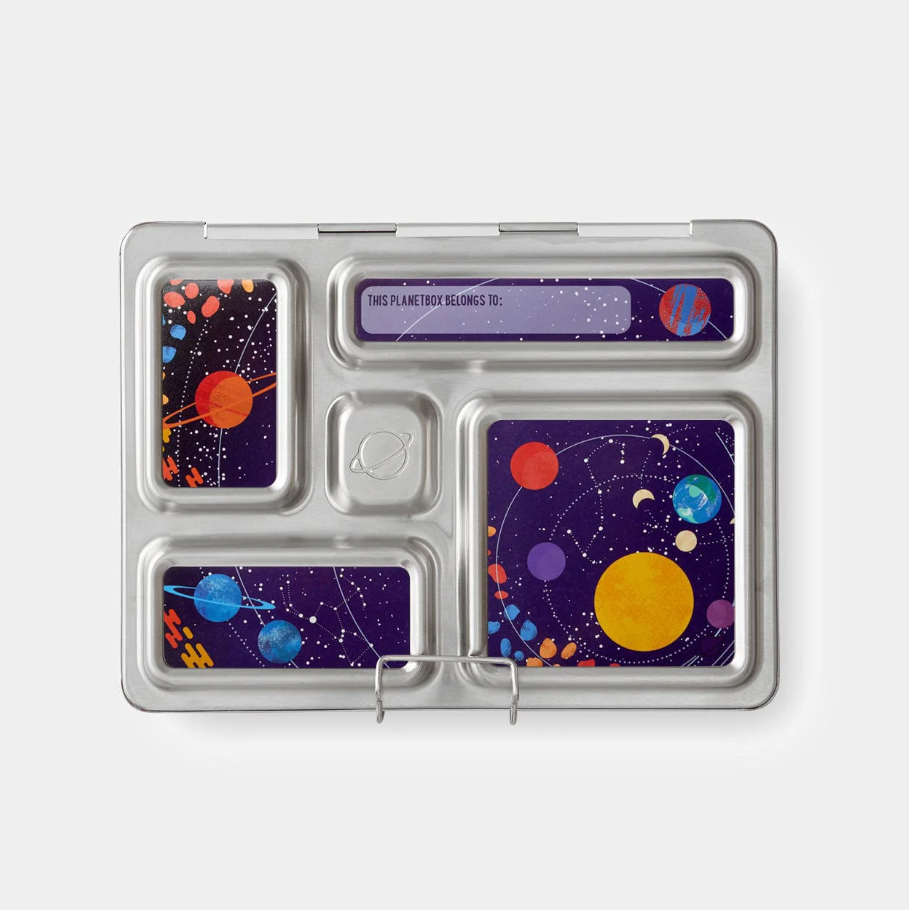
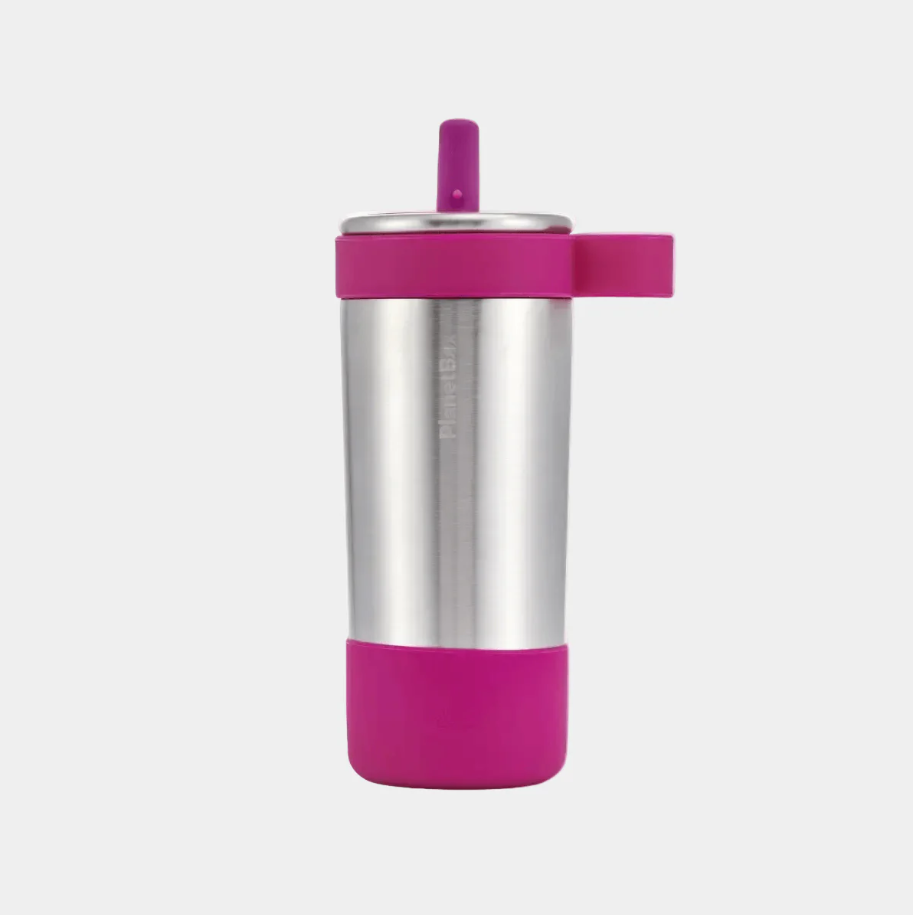
The PlanetBox Glacier is a compact insulated bottle made from 304 stainless steel and LFGB silicone, without a hard-plastic lid or drinking spout. PlanetBox states that its vacuum insulation is sealed with lead-free SAC solder made from tin, silver, and copper. The 10-ounce size and flip-up straw work especially well for preschool, lunchboxes, beach days, and younger children who need a smaller bottle.
Pros:
- No hard plastic in the bottle or lid
- 304 stainless steel and LFGB silicone
- Lead-free SAC solder
- Insulated to help keep water cold
- Compact size fits smaller backpacks and lunch bags
- Stainless steel internal straw
Cons:
- Heavier than a single-wall bottle
- Stainless steel body should be hand washed
- Complete replacement straw lids are not currently sold separately
 Klean Kanteen 12 oz Classic Kid's Insulated Water Bottle
The Klean Kanteen Kid’s Classic Insulated is a strong choice for school, beach days, travel, and other situations where keeping water cold is worth the added weight. It is made from certified 90% post-consumer recycled 18/8 stainless steel and features lead-free double-wall vacuum insulation. The leakproof Flip Seal Sport Cap includes a removable stainless steel straw and can also be used without the straw. Klean Kanteen states that the bottle keeps drinks iced for up to 40 hours and is fully dishwasher safe.
Pros:
- Lead-free insulated stainless steel construction
- Keeps drinks iced for up to 40 hours
- Leakproof Flip Seal Sport Cap
- Removable stainless steel straw
- Fully dishwasher safe
- Replacement straws and sealing gaskets available
- Narrow shape fits most cup holders
Cons:
- Weighs 10.31 ounces before adding water
- More than twice as heavy as the single-wall 12 oz version
- Cap contains plastic
- Flip Seal cap is intended for ages 4 and up
 Klean Kanteen 12 oz Classic Kid's Water Bottle
The single-wall Klean Kanteen Kid’s Classic gives children a durable stainless steel bottle without the added weight of vacuum insulation. It weighs only 4.9 ounces empty and is made from lead-free 18/8 stainless steel. The Flip Seal Sport Cap is designed to be leakproof when closed and includes a removable stainless steel straw, making this a practical everyday bottle for preschool, daycare, and outings.
Pros:
- Only 4.9 ounces empty
- Lead-free 18/8 stainless steel bottle
- Removable stainless steel straw
- Leakproof Flip Seal cap
- Dishwasher safe
- Replacement straws and sealing gaskets available
Cons:
- Not insulated
- Cap contains plastic
- Flip Seal cap is intended for ages 4 and up
 Owala FreeSip Kids Stainless Steel Water Bottle 16 oz
The Owala Kids FreeSip is a practical insulated option for preschool and school-age children who need a larger bottle they can operate independently. Its FreeSip lid allows children to drink through the built-in straw or tilt the bottle and use the larger opening. Owala states that its insulated bottles use lead-free solder, while the locking carry loop helps keep the lid closed inside a backpack.
Pros:
- Brand states that lead-free solder is used
- Built-in straw and chug opening
- Leakproof when properly closed
- Locking carry loop protects the release button
- 16-ounce capacity works well for school
- Insulated for cold drinks
Cons:
- FreeSip lid and drinking components contain Tritan plastic
- More lid components to clean than a simple chug bottle
- Stainless steel cup is best hand washed
 Hydro Flask Kids 12 oz Bottle
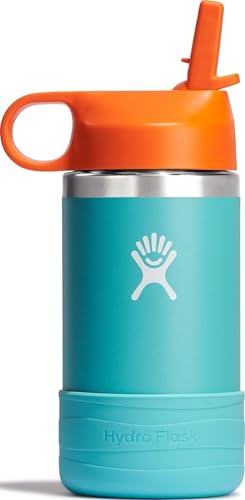
The Hydro Flask Kids 12 oz Bottle is a widely available insulated option for preschool, school, beach days, and travel. Hydro Flask states that it has sealed its vacuum-insulated bottles without lead since 2012. The slim stainless steel bottle weighs 8.8 ounces empty, keeps water cold for up to 24 hours, and includes a straw cap and protective silicone boot. It is fully dishwasher safe, although Hydro Flask describes the lid as leak-resistant rather than completely leakproof.
Pros:
- Vacuum insulation is sealed without lead
- Keeps water cold for up to 24 hours
- Includes a protective bottle boot
- Very durable
- Dishwasher safe
- Widely available online and in stores
Cons:
- Straw cap contains plastic
- Exact plastic resins are not clearly disclosed on the product page
- Leak-resistant rather than fully leakproof
- Weighs 8.8 ounces before adding water
- Intended for ages 3 and older
 Lifefactory 12 oz Glass Water Bottle
The Lifefactory 12 oz bottle pairs a simple glass drinking vessel with a protective silicone sleeve and polypropylene flip cap. The entire bottle is dishwasher safe, and Lifefactory sells replacement glass vessels if the original bottle breaks. It is a good option for older children or home use, although its weight and breakability make it less practical for toddlers carrying their own bottles.
Pros:
- Simple glass drinking vessel
- Protective silicone sleeve improves grip
- Entire bottle is dishwasher safe
- Replacement glass vessels are available
- Glass does not easily retain flavors or odors
Cons:
- Weighs approximately 0.85 pound before adding water
- Glass can still break despite the sleeve
- Polypropylene cap
- Not insulated
 Nalgene Kids 12 oz On The Fly Lock-Top Water Bottle
The Nalgene Kids’ On-The-Fly is my last-resort plastic pick for situations where stainless steel or glass is not allowed or simply will not work. Its 12-ounce Tritan Renew body weighs only 4 ounces, while the locking flip-top lid makes it easy to carry and helps prevent leaks inside a backpack. Nalgene states that the bottle is BPA- and BPS-free, dishwasher safe, durable, and odor resistant. I still strongly prefer stainless steel or glass for the main drinking vessel, so I would only choose this one when plastic is truly the only practical option.
Pros:
- Weighs only 4 ounces
- BPA- and BPS-free Tritan Renew body
- Locking flip-top drinking spout
- Leakproof when properly closed
- Dishwasher safe
- Carry loop can attach to a backpack
- Compact 12-ounce size
Cons:
- Plastic bottle body and lid
- Not insulated
- The latch may be difficult for some younger children to close independently
- Condensation can form on the single-wall bottle
❓ What About YETI, CamelBak, Thermos and Simple Modern?
Several popular bottles did not make my top tier, but not because I think every one is unsafe.
YETI Rambler Jr.
YETI is very transparent that the sealing bead in its vacuum-insulated Rambler drinkware contains lead, is fully encapsulated, and is designed to remain inaccessible. YETI also publishes third-party testing information showing no detectable lead in tested food-contact material at the stated detection limit.
That is a much better disclosure than silence.
I still prefer Owala, PlanetBox or Klean Kanteen for a child because those brands offer insulated bottles with lead-free solder.
CamelBak
CamelBak similarly states that some bottles use lead-containing exterior solder under a protective cover, while the steel vessel, paint and plastic cap are tested for user/contact safety.
Again, this is not evidence that a child drinking from an intact CamelBak is being exposed to lead. It simply does not meet my preferred no-lead construction standard when other good choices do.
Thermos FUNtainer
Thermos gives excellent material disclosure for the FUNtainer lid: polypropylene lid, silicone straw spout and LDPE stem. It also sells replacement lids and straw parts.
For lead, Thermos says its products are independently tested and “do not pose a risk of lead exposure to consumers.” That is reassuring, but it is not the same statement as “no lead is used anywhere in construction.”
Since other manufacturers provide the stronger disclosure I am looking for, FUNtainer does not make my top tier.
Simple Modern Summit Kids
The 14 oz Summit Kids bottle has plenty going for it practically: double-wall stainless steel, BPA-free plastic lid and straw, top-rack dishwasher compatibility, and a manufacturer-rated leakproof straw lid when closed.
Simple Modern says its accessible components are made without BPA, regulated phthalates, lead or cadmium and that products are tested through independent accredited labs.
“Accessible components” is narrower than an explicit no-lead manufacturing statement, so it stays below my verified lead-free insulated picks.
This is a transparency ranking, not a declaration that these bottles are hazardous.
Kids’ Water Bottle Sizes: What Actually Makes Sense?
There is no single correct bottle size by age.
The better question is how much water the child needs to carry at one time, how easily they can refill, and how heavy the bottle becomes when full.
Toddlers
Roughly 9 to 12 ounces is a useful starting range for independent carrying.
A small Pura or PlanetBox makes more sense to me than putting a 24 oz insulated bottle in a toddler backpack. The child can actually lift it, fit it into a small side pocket, and drink without wrestling with the bottle.
Preschool
12 to 16 ounces works for many preschool routines.
Consider whether teachers refill bottles, whether it sits in a classroom cubby or gets carried around, and how easily your child can operate the lid without help.
Elementary School
16 to 20 ounces becomes more practical, particularly where refill opportunities are limited.
This is where I like the 16 oz Owala Kids FreeSip or larger Hydro Flask options.
Daycare
Prioritize a compact bottle, clear name labeling, simple assembly, and the daycare’s material rules.
A dishwasher-safe bottle becomes especially attractive when the bottle comes home every evening with remnants of crackers, sandbox dust and whatever mysterious substance toddlers manufacture with their hands.
Beach and Outdoor Days
Insulation becomes much more useful here.
A 10 or 12 oz insulated bottle may work for a small child if an adult can refill it. An older child may need 16 to 20 ounces.
Travel
Cup-holder fit and weight matter.
A giant bottle may reduce refills, but it also consumes precious backpack space and gets progressively less charming when you are already carrying snacks, wipes, extra clothing and a child who suddenly cannot walk.
Straw vs. Chug vs. Open Spout for Kids
Straw
Straws work especially well for toddlers and preschoolers because children can sip without tipping a heavy bottle toward their face.
The tradeoff is cleaning.
Every removable straw, valve and gasket creates another place that has to be washed, dried and occasionally replaced.
Pura simplifies the materials with silicone. Klean Kanteen uses a removable stainless straw. PlanetBox also uses a stainless internal straw in the Glacier.
Chug
Chug lids usually reduce straw parts and allow faster drinking.
They are often easier to inspect visually, which I like.
The drawback is flow. A young child can tip too much water toward their face, and screw caps require more coordination.
PlanetBox’s Glacier Chug lid is stainless steel and LFGB silicone, but current buyer feedback on PlanetBox’s own site shows that some younger children find the screw cap harder to operate independently.
Open Spout
A simple open spout has fewer internal pieces and less hidden plumbing to clean.
It also has very little between “drinking” and “waterfall.”
I prefer it for older children who have the coordination to manage flow and remember to close the bottle properly.
Which Kids’ Water Bottles Are Actually Leakproof?
“Leakproof” gets thrown around too casually.
There are three different things I care about:
- What the manufacturer actually claims.
- Whether the bottle must be closed or locked in a particular way.
- Whether the claim still holds after normal disassembly and reassembly.
Among my top picks:
Klean Kanteen Flip Seal: Manufacturer says 100% leakproof.
Owala Kids FreeSip: Manufacturer says leakproof when closed. The carry loop doubles as a lock.
PlanetBox Glacier straw version: PlanetBox describes the straw as spill-proof and says flipping it down secures leakproof storage.
Nalgene Kids’ On-The-Fly: Nalgene describes the locking top as leak-proof and spill-proof and covers it with the brand’s Leak-Proof Guarantee.
Pura Kiddo: Pura describes the straw’s sip guard as providing extra spill protection, but I would not upgrade that wording to “leakproof.”
Lifefactory Active Cap: I did not find a comparable manufacturer leakproof claim for the current 12 oz bottle, so it is not my first backpack choice.
Assembly matters too. A gasket seated incorrectly or straw pushed against the bottom of a bottle can alter how a lid behaves. Klean Kanteen specifically gives troubleshooting instructions for this on the Flip Seal.
The Easiest Kids’ Water Bottles to Clean
My winner here is the single-wall Klean Kanteen Kid’s Classic.
The entire bottle is dishwasher safe. The stainless straw removes easily. The main sealing gasket can be removed, replacement gaskets are available, and Klean publishes instructions for cleaning the cap with the spout open and allowing it to air dry completely.
Pura is also strong because its silicone top can be removed and the bottle is dishwasher safe.
Nalgene is straightforward and dishwasher safe, although the toddler valve system still needs to be inspected and cleaned.
Owala is easier to disassemble than many complicated straw lids, but the brand recommends hand washing the stainless cup.
PlanetBox loses points because the Glacier stainless vessel should be hand washed to preserve its vacuum seal, though the lid and silicone boot can go in the dishwasher.
Lifefactory gets bonus points for letting you put the glass bottle, silicone sleeve and cap into the dishwasher without peeling the sleeve off every night.
What about mold?
Any lid that traps moisture, residue or debris can become unpleasant if it is repeatedly closed while wet.
Rather than declaring one bottle “mold-proof,” I favor designs where the wet surfaces can be seen, washed and dried.
A replaceable gasket is better than pretending the gasket never needs attention.
Best Water Bottle for Toddlers
Best: Pura Kiki 11 oz Kiddo Straw
Pura is my toddler winner because the 11 oz size is manageable, the straw is soft silicone, there is no hard plastic in the drinking system, and the two-piece straw lets parents adapt the bottle to the child’s drinking style.
The manufacturer lists the Kiddo straw for ages six months and older.
Runner-Up: PlanetBox Glacier 10 oz
Choose the Glacier instead when keeping water cold matters more.
The 10 oz capacity remains reasonable for a small child, the lid avoids hard plastic, and PlanetBox uses lead-free solder in the insulated body.
For a toddler expected to carry the bottle independently all day, I would still compare its filled weight with the lighter Pura before deciding.
Best Water Bottle for Preschool and School
Preschool: Klean Kanteen 12 oz Kid’s Classic
This is where its 4.9 oz empty weight earns its keep.
A preschooler gets stainless steel and a straw lid without the weight of a heavy insulated bottle. The Flip Seal cap is intended for ages three and older.
Elementary School: Owala Kids FreeSip 16 oz
The larger 16 oz capacity, locking loop, leakproof closed lid and dual drinking method make more sense once children can comfortably handle a bigger bottle.
For families trying to minimize plastic contact, I would step up to a larger Klean Kanteen or one of PlanetBox’s current 20 oz stainless-and-silicone bottles instead.
PlanetBox’s current 20 oz insulated bottles use stainless steel and silicone and the same SAC lead-free solder system, with the brand rating them for up to 20 hours cold.
Do Kids Need an Insulated Water Bottle?
Not necessarily.
Insulation is helpful when:
Single-wall stainless makes more sense when:
For a toddler, I would rather have a 5 oz empty bottle they can comfortably use than a beautifully insulated bottle they hand back to me after four minutes.
Insulation is a feature, not a safety requirement.
What I Avoid in Kids’ Water Bottles
Unclear construction
“Food-grade stainless steel” tells me far less than a manufacturer identifying its steel, lid materials and solder.
Lead-containing vacuum solder
Encapsulation can prevent exposure, but I would rather skip lead in construction for children when brands already demonstrate that it is unnecessary.
Mystery interior coatings
Stainless steel does not inherently need a liner.
Vague plastic descriptions
I prefer knowing whether a cap is polypropylene, Tritan or another material.
Complicated valves with inaccessible wet areas
Fewer hidden channels make inspection easier.
Proprietary parts that cannot be replaced
One missing straw should not turn the entire bottle into garbage.
Needlessly heavy bottles for very young children
An adult-size insulated bottle can be technically excellent and still be a terrible toddler bottle.
Marketing that outruns documentation
A leaf logo and the word “eco” do not tell me what is touching the water.
How to Make a Kids’ Water Bottle Last Longer
Frequently Asked Questions
Final Takeaway
The best non-toxic kids’ water bottle is not simply the one with a stainless steel body.
For younger children, weight and drinking independence can matter as much as insulation. For school, leak resistance and replacement parts become much more important. For material-conscious families, lead-free construction and clear lid disclosures help separate otherwise similar bottles.
That is a much more useful standard than buying the bottle with the prettiest “BPA-free” sticker.