Spring cleaning makes me want to open every window and “fresh start” my whole house in one afternoon.
Spring cleaning also makes it very easy to accidentally hotbox your home with harsh fumes that do not need to be there.
This is my full guide on non-toxic cleaning products, written for parents, sensitive households, and anyone who wants safer swaps without turning cleaning into a second job.
Quick answers
If you want the short version before we go deeper, start here.
What I consider non-toxic cleaning products
I use “non-toxic” as shorthand for “lower risk and more transparent,” not as a promise that a product is perfect in every context.
The FTC’s Green Guides are blunt about this: if a company claims something is “non-toxic,” they should have competent and reliable scientific evidence, and the claim may need clear qualifications to avoid being misleading.
That’s why I add “greenwashed” brands to avoid in many of my guides.
In my house, I focus on what I can control: disclosure, ventilation, and not using heavy-duty chemicals when I do not need them.
❌ My dealbreakers
I skip products when:
✅ Better choices I look for instead
Sometimes reading ingredient lists can be daunting, especially with cleaning products. A tip I use when I’m too tired to do a deep dive: if you can’t pronounce it, skip it.
I’m looking for non-toxic cleaning products that reduce irritants, cut down on indoor VOC load, and still clean my real-life messes.
These are the green flags that matter most:
If you want to see how I apply these standards to specific categories
start with kitchen basics
What to avoid and why
I’m not going to give you a 200-ingredient blacklist.
I am going to give you the small handful of categories that cause the most “why do I feel like garbage after cleaning?” moments in real homes.
☣️ Undisclosed fragrance
If you’ve been reading my blog for a while you might be tired of hearing me go on about fragrance. But it’s soooo important!
Fragrance is complicated because it is often a mixture of chemicals and not fully disclosed to consumers (it’s not required).
Fragrance can also be a real trigger for headaches, breathing discomfort, and skin reactions in some people, and the large survey-based study I mentioned earlier reinforces that this is a common lived experience.
If you’ve ever felt funny walking past the cleaning aisle at the store, you can relate to this.
Plus, if endocrine disruption is one of your concerns, phthalates are worth understanding.
EPA notes some phthalates are suspected endocrine disruptors, meaning they may interfere with the body’s natural hormones.
This is why I always talk about fragrance: fragrance-free swaps are one of the most practical and immediate steps you can take.
☣️ Routine use of harsh fumes without ventilation
The EPA’s VOC overview is one of the clearest explanations of why cleaning can affect indoor air.
EPA explains that VOCs are emitted as gases from certain solids or liquids, that concentrations are often higher indoors (up to ten times higher), and that VOCs are emitted by a wide array of products, including cleansers, disinfectants, aerosol sprays, and air fresheners.
EPA also lists possible health effects and notes that the extent and nature of any effect depends on many factors, including level and duration of exposure.
This is why I try to keep it simple: “reduce obvious exposures, ventilate, do not mix products, and use the least intense product that can do the job.”
☣️ Mixing bleach with other cleaners
Bleach has a long history of people accidentally making toxic gas in their bathroom because someone used bleach after an ammonia-based product.
Washington State’s Department of Health warns that mixing bleach and ammonia produces toxic chloramine gases and lists symptoms like coughing, nausea, shortness of breath, watery eyes, and chest pain.
EPA simplifies the rule for everybody: never mix household care products unless the label directs you to.
My personal rule: I do not use bleach for household cleaning.
☣️ Ammonia as an everyday cleaner
CDC notes that exposure to high levels of ammonia may hurt your skin, eyes, throat, and lungs and can cause coughing and burns.
Ammonia also becomes a bigger risk when people later use bleach around the same area, because of the chloramine issue.
So in a home with kids, pets, or tired adults cleaning at night, I treat ammonia as an unnecessary ingredient.
☣️ “Antibacterial” as a default setting
When a label screams “antibacterial,” it’s trying to make you feel safe.
The problem is that “more antibacterial” is not automatically “more helpful” for daily life.
CDC’s guidance emphasizes that, in most situations, cleaning alone with soap and water can remove most germs on surfaces, and that disinfecting at home is likely not needed unless someone is sick or someone sick has recently visited.
FDA also states there isn’t sufficient evidence that OTC antibacterial soaps are better at preventing illness than washing with plain soap and water.
That combination is enough for me to skip the “antibacterial everything” approach.
☣️ Scary-sounding chemicals that deserve context
Formaldehyde is a good example of why nuance matters.
EPA calls formaldehyde “one of the best known VOCs,” and notes it is one of the few indoor air pollutants that can be readily measured.
NTP’s Report on Carcinogens profile states formaldehyde is known to be a human carcinogen.
The American Cancer Society notes IARC has concluded formaldehyde is carcinogenic to humans, based on evidence including nasopharyngeal cancer.
Does that mean every whiff of anything is catastrophic?
No.
It means I take ventilation seriously, store chemicals safely, and avoid needless high-emission products when a simpler option will clean the mess.

What to look for instead
Non-toxic cleaning products actually make your cleaning routine gets easier, not harder.
The goal is to buy fewer things, understand them better, and use them correctly.
Start with cleaning, then decide if you need more
CDC is clear that cleaning is an important first step and removes germs and dirt on surfaces.
CDC also notes surfaces should be cleaned before you sanitize or disinfect because dirt can make it harder for chemicals to kill germs.
In real life, that means the boring stuff works:
Disinfect with intent, not anxiety
When you truly need a disinfectant, I want you to use one that’s regulated and that you follow correctly.
EPA explains disinfectants are pesticides. They register antimicrobial pesticides and approve label language, and verify disinfectants work according to their label directions.
EPA also spells out why label directions matter, including the “Directions for Use” section.
So my “safer” disinfecting approach is:
If you want a shortlist of spring cleaning products that fit this approach, read this post.
Pay attention to how the product is used
This is the sneaky part most people miss.
The same cleaner can feel totally different depending on whether it’s a spray in a tiny bathroom or a liquid you apply with a damp cloth in a ventilated room.
And there’s research suggesting the spray format itself matters.
A frequently cited study in adults found that common, nonprofessional use of household cleaning products in spray form is associated with new-onset asthma and asthma outcomes, especially at higher frequency of spray use.
So if your home is asthma-prone or scent-sensitive, I’d rather see:
If your household is sensitive and you want a “start here” swap that tends to matter fast, laundry is still my first stop.
How I choose products
Some people might think this is overkill, but I am okay with that.
I’d rather be picky than constantly annoyed by mystery scents and headachey cleaning sessions.
My 60-second label screen
When I pick up a product, I do this:
How I try new cleaners in my own home
When I test non-toxic cleaning products in my home, I pay attention to three things: does it clean the mess I actually have, does it leave a residue I can feel, and does it stink up my space.
For residue, I do a very scientific method known as: rinse, dry, and run my hand over the surface.
If it feels sticky, I know it will attract dust faster, and I also know I’m going to hate my life the next time I clean.
For scent, my standard is simple: it shouldn’t give me the creeps.
If a product perfumes my whole house, it’s adding to indoor air pollution instead of reducing it.
A tiny “examples I trust” list
my favorite dish soap
Yaya Maria’s
Buy directly from their website and use code NATURALLYNONTOXIC for 10% off.
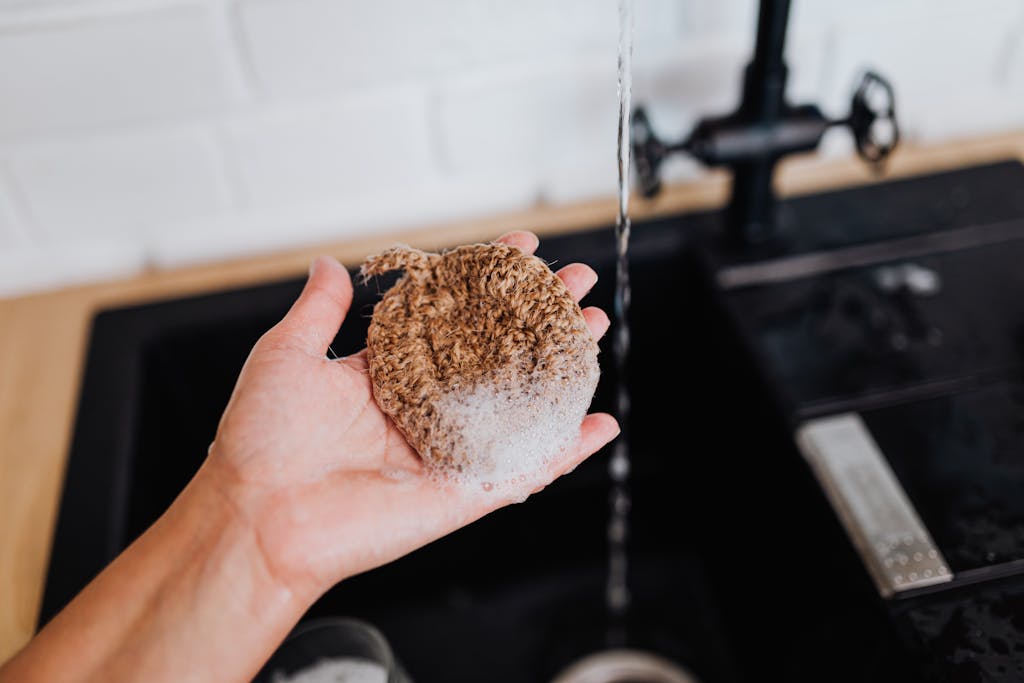
Branch Basics is super popular in non-toxic households, and for a good reason. It’s one concentrate that replaces practically all of your old spray bottles that rely on ammonia and synthetic scent boosters.
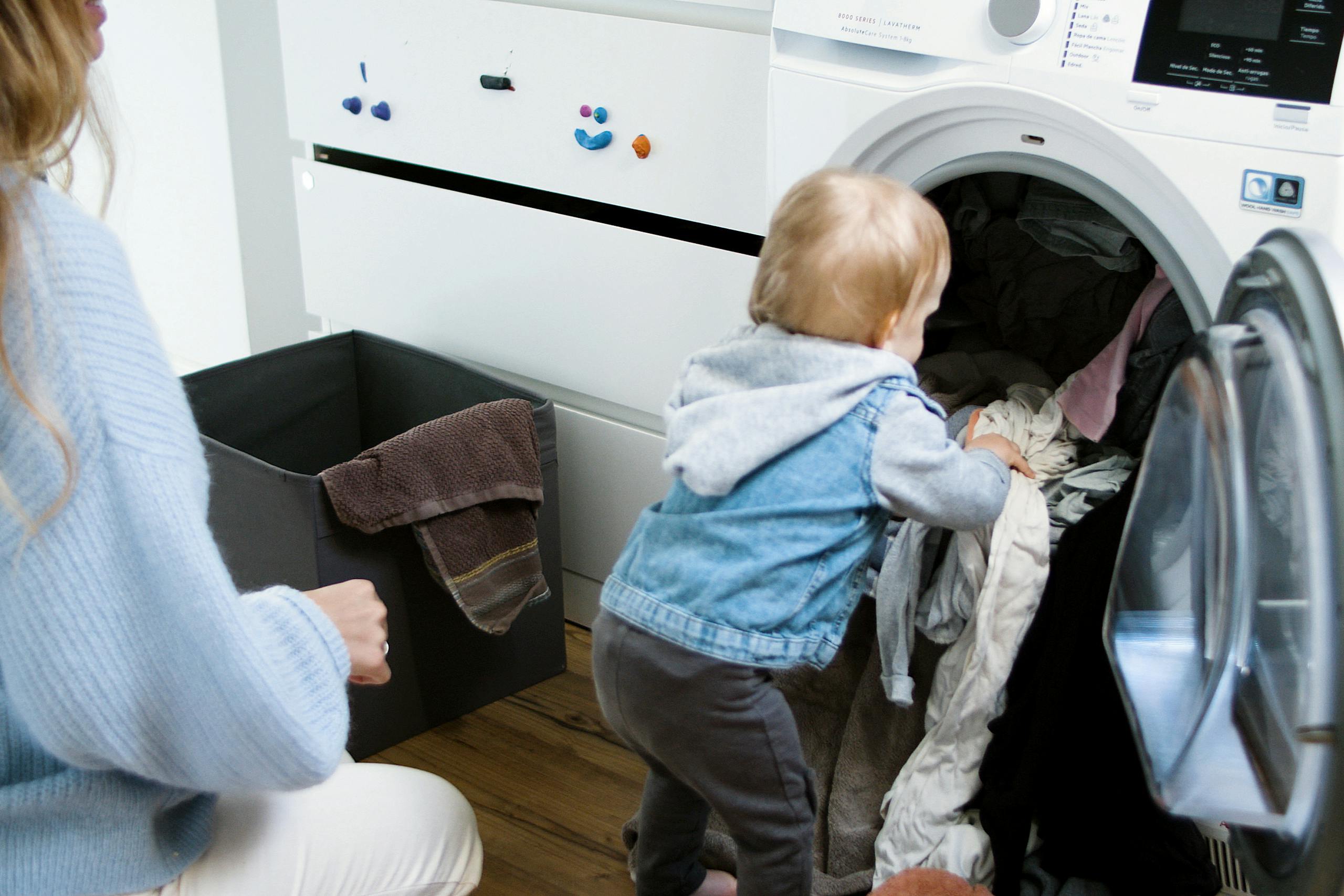
If you haven’t joined the club yet, give it a shot. When I first switched, I was surprised at how well it cleans and how many things you can use it for. One bottle lasts me a pretty long time, and that’s with cleaning up after kids…

If you want my specific picks and “clean ones to skip” lists
those live in the dedicated posts so I can update them more often

How to choose based on real-life constraints
I love a perfect routine in theory.
In practice, I’m writing this for people who are cleaning with one hand while holding a snack cup with the other.
If you’re on a budget
Replace products as you run out.
EPA’s VOC guidance even includes practical steps like buying limited quantities you will use soon, and disposing of old chemicals safely, which aligns nicely with the “replace slowly” approach.
Start with your highest-contact items:
If detoxing your laundry routine feels overwhelming to you, start here.
If you have no time
Pick one “universal” swap.
For most homes, that means fragrance-free laundry or an all-purpose cleaner you can use on most surfaces.
Then stop.
Take it one swap at a time, and prioritize progress over perfection.
If your home is fragrance-triggered
This is where I get picky:
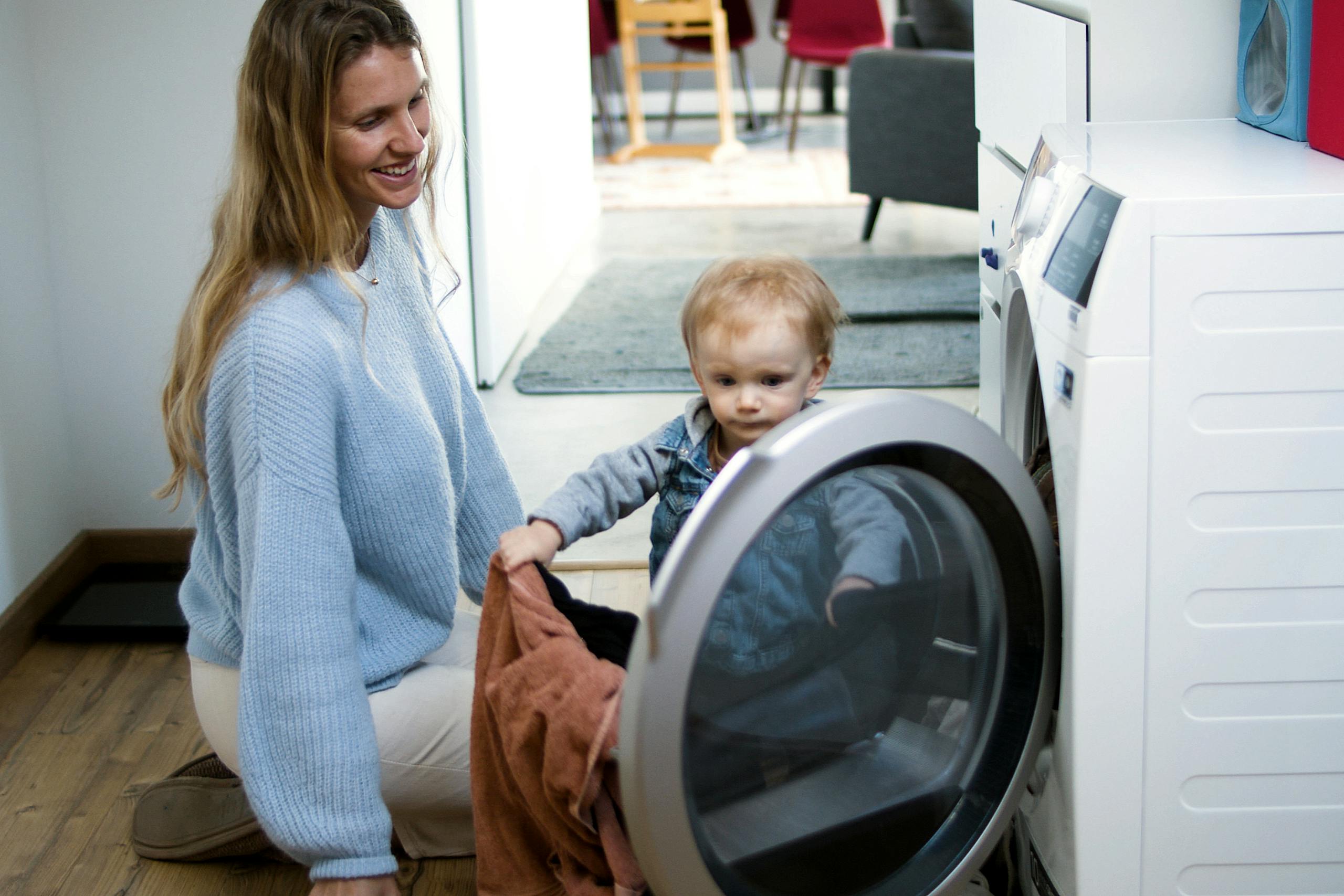
If you have babies, toddlers, or pets
National poison center data shows household cleaning substances are one of the most common exposure categories in children age 5 and under.
EPA’s VOC guidance also includes “keep out of reach of children and pets” as a basic exposure-reduction step.
Although choosing non-toxic cleaning products is better than having bleach and ammonia in your cabinet, that doesn’t mean they are meant to be ingested by littles.
Put cleaning products up high or locked.
Keep products in original containers so labels stay intact.
If you live in a small space with limited ventilation
This is where “non-toxic cleaning” is less about ingredients and more about exposure.
Cleaning products can contribute to indoor VOCs, and VOC concentrations can be higher indoors than outdoors.
So in a small apartment, I prioritize:
If air quality is a core stressor for your home, consider an air purifier.
Room-by-room priorities that keep it simple
If you do nothing else, do this
01.
Swap laundry to fragrance-free.
02.
Choose a non-toxic all-purpose cleaner.
03.
Detox your dishwashing routine.
Common mistakes and myths
Common mistakes I see over and over
Mistake: treating scent as proof of cleanliness.
Fragrance can add VOCs and can be associated with reported health effects in some people, so scent is not a reliable “clean” signal.
Mistake: disinfecting everything every day.
CDC guidance says disinfecting at home is likely not needed unless someone is sick or recently visited, and cleaning alone removes most germs in most situations.
Mistake: assuming a disinfectant “works” because it says disinfectant.
EPA says it verifies disinfectants work according to label directions, and it emphasizes reading and understanding the label.
Myths worth retiring
Myth: “Non-toxic” is a regulated, consistent label.
FTC guidance shows “non-toxic” claims require evidence and can be misleading without proper qualification.
Myth: “Antibacterial” is always better.
FDA says there isn’t sufficient evidence OTC antibacterial soaps are better than plain soap and water.
Myth: You need bleach for a “real” clean.
CDC’s guidance on home cleaning does not require bleach for routine cleaning, and EPA emphasizes ventilation and safe use for products that emit VOCs.
Some frequently asked questions
Conclusion
A healthier spring clean does not require panic, perfection, or a cabinet full of “miracle” sprays.
It usually requires fewer products, better ventilation, and a smarter line between cleaning and disinfecting.
What to swap next?
View all Cleaning posts
References
- US CDC. When and How to Clean and Disinfect Your Home.
https://www.cdc.gov/hygiene/about/when-and-how-to-clean-and-disinfect-your-home.html - US EPA. Volatile Organic Compounds’ Impact on Indoor Air Quality.
https://www.epa.gov/indoor-air-quality-iaq/volatile-organic-compounds-impact-indoor-air-quality - Steinemann A. Fragranced consumer products: exposures and effects from emissions. Air Quality, Atmosphere & Health (2016). PubMed record.
https://pubmed.ncbi.nlm.nih.gov/27867426/ - US EPA. Biomonitoring: Phthalates (suspected endocrine disruptors) – America’s Children and the Environment.
https://www.epa.gov/americaschildrenenvironment/biomonitoring-phthalates - National Toxicology Program (NTP). Report on Carcinogens: Formaldehyde (RoC profile PDF).
https://ntp.niehs.nih.gov/sites/default/files/ntp/roc/content/profiles/formaldehyde.pdf - US CDC. Ammonia: Chemical Fact Sheet.
https://www.cdc.gov/chemical-emergencies/chemical-fact-sheets/ammonia.html - Washington State Department of Health. Dangers of Mixing Bleach with Cleaners (chloramines).
https://doh.wa.gov/community-and-environment/contaminants/bleach-mixing-dangers - US CDC. Handwashing Facts (consumer antibacterial soap context).
https://www.cdc.gov/clean-hands/data-research/facts-stats/index.html - US FDA. Consumer Antiseptic Wash Final Rule: Questions and Answers.
https://www.fda.gov/regulatory-information/search-fda-guidance-documents/consumer-antiseptic-wash-final-rule-questions-and-answers - US CDC. The Difference Between Cleaning, Sanitizing, and Disinfecting (PDF).
https://www.cdc.gov/hygiene/pdf/331782-a_cleaning_sanitizing_disinfecting_508.pdf - US EPA. Selected EPA-Registered Disinfectants.
https://www.epa.gov/pesticide-registration/selected-epa-registered-disinfectants - US EPA. Learn About the Safer Choice Label.
https://www.epa.gov/saferchoice/learn-about-safer-choice-label - MADE SAFE. What MADE SAFE screens for (hazard categories).
https://madesafe.org/pages/made-safe - Nordic Swan Ecolabel. Chemicals harmful to health (restrictions/bans overview).
https://www.nordic-swan-ecolabel.org/nordic-ecolabelling/environmental-aspects/chemicals-nano-and-microplastics/chemicals-harmful-to-health/ - US EPA. Guide to Air Cleaners in the Home.
https://www.epa.gov/indoor-air-quality-iaq/guide-air-cleaners-home - National Poison Data System (NPDS). Annual report summary (2024 report). PubMed record.
https://pubmed.ncbi.nlm.nih.gov/41432769/ - US FTC. Environmental Claims: Summary of the Green Guides.
https://www.ftc.gov/business-guidance/resources/environmental-claims-summary-green-guides